

Tajweed rules are the essential guidelines for correct Quranic recitation, ensuring proper pronunciation, articulation (Makharij), and melodic flow. Key Tajweed rules include governing Noon/Meem Sakinah (clear/hidden/merged sounds), Qalqalah (echoing letters), Madd (lengthening), and heavy/light letters (Tafkhim/Tarqiq), aimed at preserving the intended meaning of the text.
The Quran is not only meant to be read; it is meant to be recited with precision, beauty, and reverence. From the time of the Prophet Muhammad (peace be upon him), the words of the Qur’an have been preserved through careful memorization and accurate recitation. One of the most important sciences that protects the correct pronunciation and rhythm of the quran is tajweed. For every Muslim who desires to improve their reading and reciting, understanding the tajweed rules is essential.
This complete beginner’s guide will walk you step by step through the Basic Rules of Tajweed, the deeper principles behind them, and how you can master the Tajweed Rules of the Qur’an effectively.
What are the Tajweed Rules?
The word tajweed comes from the Arabic root “j-w-d,” which means to improve or make better. In the context of the Qur’an, tajweed refers to the set of precise rules that govern how each letter should be pronounced, how sounds interact, and how words flow together during recitation. The tajweed rules ensure that every letter is given its due right without addition, distortion, or omission.
When we talk about the Basic Rules of Tajweed, we are referring to principles that control pronunciation, articulation points, characteristics of letters, elongation, merging, and clarity. These rules were not invented by scholars; rather, they were derived from how the Prophet Muhammad (peace be upon him) recited the quran. Scholars later documented these rules so that future generations could continue reciting the Qur’an correctly. If you’re interested, take a look at Quran recitation course. Worth a look: Quran with Tajweed.
Without tajweed, subtle mistakes can completely change meanings. A slight alteration in a vowel length or a heavy letter pronounced lightly can transform a word into something entirely different. This is why mastering the Tajweed Rules of the Qur’an is not merely about beautification; it is about preservation. For further reading, take a look at Rules of Tajweed course. This connects well with Quran reading with Tajweed.
Key Tajweed Rules for Beginners
Key Tajweed Rules for Beginners:
- Noon Sakinah and Tanween: When a noon with no vowel (نْ) or double vowel (ً ٍ ٌ) appears, it is treated in four ways:
- Izhar (Clear): Pronouncing the sound clearly (letters: ء هـ ع ح غ خ).
- Idgham (Merging): Merging the sound into the next letter (letters: ي ر م ل و ن).
- Iqlab (Conversion): Changing the noon/tanween sound into a “Meem” (م) sound (letter: ب).
- Ikhfaa (Concealment): Hiding the sound with nasalization (15 remaining letters).
- Meem Sakinah Rules (مْ):
-
- Idgham Shafawi: Merging with another Meem.
- Ikhfaa Shafawi: Concealing the Meem when followed by ‘Baa’ (ب).
- Izhar Shafawi: Pronouncing the Meem clearly for all other letters.
- Qalqalah (Echoing): A bouncing sound made on five letters (ق ط ب ج د) when they have a sukoon (silent). The bounce is lighter in the middle of a word and stronger at the end.
- Madd (Prolongation): Extending vowels (Alif, Waw, Yaa) based on specific rules, usually 2, 4, 5, or 6 beats, especially if followed by a Hamza (ء) or Sukoon (ـۡـ).
- Ghunnah (Nasalization): A required buzzing sound (usually 2 beats) whenever a Noon (نّ) or Meem (مّ) has a Shaddah.
- Heavy and Light Letters (Tafkhim and Tarqiq):
- Heavy (Full Mouth): Letters like ص ض ط ظ غ ق خ, which are always pronounced with a thick sound.
- Light (Thin Mouth): All other letters.
- Letter Raa (ر): Rules for when it is heavy or light.
- Makharij (Articulation Points): The 5 main points of articulation: Throat, Tongue, Lips, Nose, and Cavity.
Learn Tajweed Rules Online for Kids and Adults
In today’s digital age, learning the tajweed rules has become more accessible than ever. Both kids and adults can benefit from structured online programs that provide personalized instruction. Platforms such as the Leading platform Easy Tajweed Academy offer step-by-step guidance, interactive Tajweed lessons online, and experienced teachers who help students master Tajweed from the comfort of their homes. You can also explore Quran for children for additional guidance. Related reading: check out Online Quran classes UK.
For children, online Tajweed classes use engaging methods, repetition, and gentle correction to help them develop accurate recitation habits early. Adults, even those starting from a basic level, can progress steadily with guided lessons that focus on correcting long-standing pronunciation mistakes. See also Quran recitation online for more details. If you’re interested, take a look at Ijazah course online easytajweedacadem.
Online learning offers flexibility, recorded sessions for revision, and one-on-one correction—an essential component of mastering the Tajweed Rules of the Qur’an. Since tajweed cannot be perfected by theory alone, live correction while reciting is crucial. For more on this, take a look at our The virtues of reciting Quran. See also How to learn Quran with Tajweed for more details.
Types Of Tajweed Rules with Examples
Tajweed includes key rules such as Tafkhim (emphasizing heavy letters like ‘ق’) and Tarqiq (softening light letters like ‘ي’), Idghaam (merging sounds, e.g., نُونٌ سَاكِنَةٌ into a following letter with ghunnah), Iqlaab (changing ‘ن’ to ‘م’ before ‘ب’, e.g., ‘أَنْ بَلَغَ’), and Qalqalah (reverberation on certain letters like ‘ت’, ‘ث’, ‘ق’, ‘ب’, ‘ج’). Examples include ‘قَرَأَ’ (with tafkhim) and ‘نَزَلَ’ (with qalqalah). These rules ensure accurate, melodious recitation of the Quran. For further reading, take a look at Quran academy near me.
The tajweed rules can be divided into several main categories, each governing a different aspect of recitation. These include articulation rules, letter characteristics, rules of noon and tanween, meem saakin rules, Qalqalah, and Madd rules. Worth a look: Peaceful teachings of Islam.
For example, when a noon saakin is followed by one of the throat letters, the rule applied is izhaar, meaning clarity. The noon sound must be pronounced clearly without merging or nasalization. In contrast, when certain letters follow noon saakin or tanween, merging (Idgham) may occur.
Another example is Qalqalah, which applies to specific letters that create a slight echoing sound when they appear in a state of sukoon. Madd rules control how long vowels are stretched, sometimes two counts and sometimes up to six counts, depending on the context.
Each category of the Basic Rules of Tajweed works together to produce a harmonious and accurate recitation of the Qur’an.
Understanding Makharij: Correct Pronunciation of Arabic Letters
Makharij refers to the articulation points from which letters emerge. Mastering Makharij is the foundation of all tajweed rules. Arabic letters originate from five main areas: the throat, tongue, lips, nasal passage, and chest.
For instance, letters like “ع” and “ح” come from deep in the throat, while letters like “ب” and “م” come from the lips. If these articulation points are incorrect, the entire recitation becomes flawed.
When reading the Qur’an, every letter must be pronounced from its correct Makharij. Beginners often confuse letters that sound similar, such as “س” and “ص” or “ت” and “ط”. Tajweed ensures these letters remain distinct.
By focusing on Makharij first, students build a strong basic foundation that supports all other rules.
Characteristics of Letters (Sifaat) in Tajweed Rules
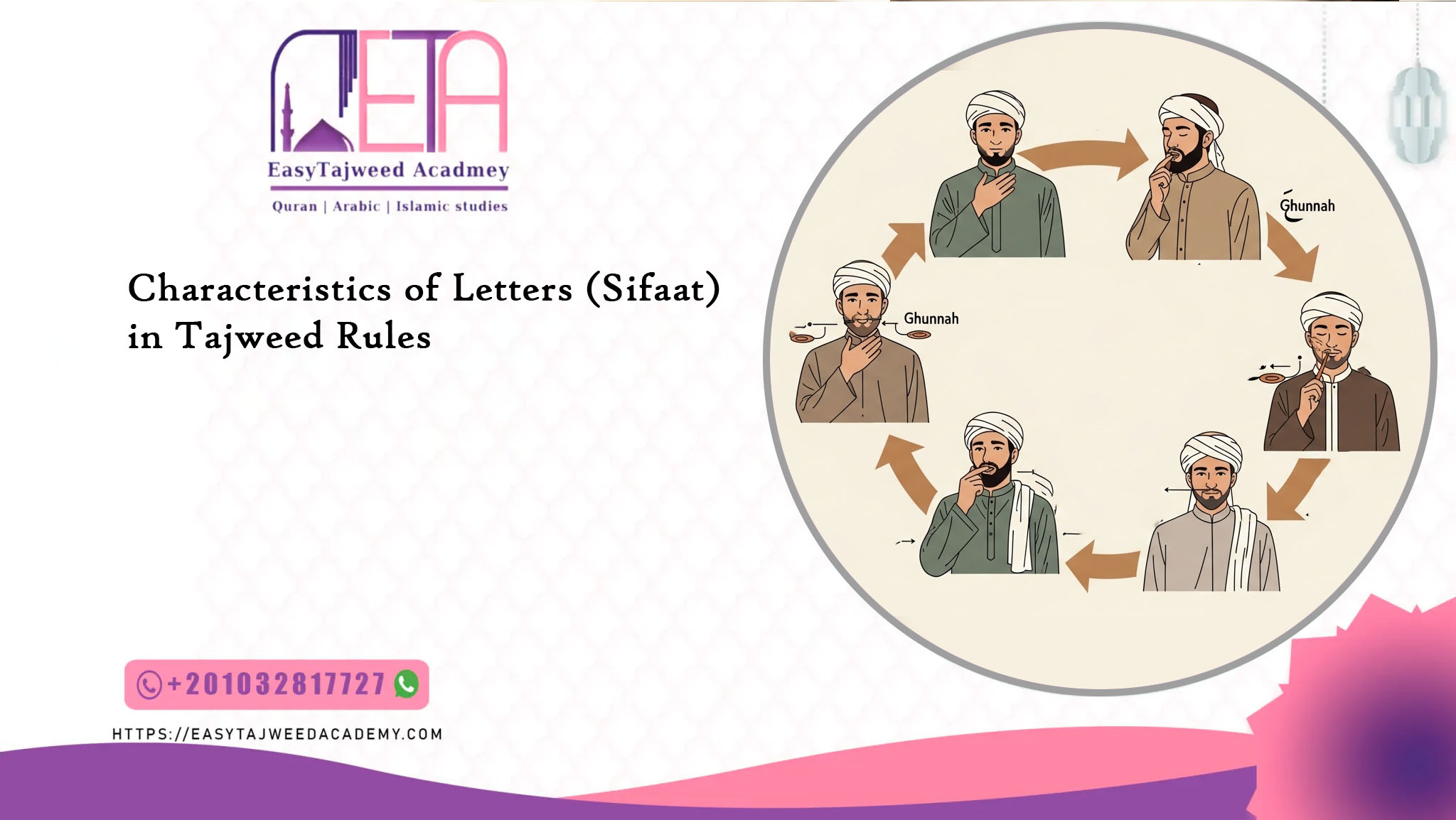
Sifaat describes the qualities or characteristics of letters. While Makharij determines where a letter comes from, Sifaat determines how it sounds. Some letters are heavy (Tafkheem), while others are light (Tarqeeq). Some letters have whispering sounds, while others are strong and forceful.
Understanding Sifaat helps prevent blending letters incorrectly during recitation. For example, heavy letters such as “ق” and “ط” must be pronounced with fullness, while lighter letters remain soft.
The Tajweed Rules of the Qur’an require attention to both articulation and characteristics. Ignoring Sifaat can lead to incorrect reading, even if the articulation point is correct.
Rules of Noon Saakin and Tanween Explained with Examples
The rules of noon saakin and tanween are among the most important tajweed rules. These rules determine how the “n” sound behaves when followed by different letters.
There are four main rulings: izhaar (clarity), Idgham (merging), Iqlab (conversion), and Ikhfa (concealment). In izhaar, the noon sound is pronounced clearly when followed by throat letters. In Idgham, the noon or tanween merges into the next letter. In Iqlab, the sound changes into an “m” sound. In Ikhfa, the sound is partially hidden with nasalization.
These rules refine the flow of reciting and protect the structure of the Qur’an.
Meem Saakin Rules in Tajweed: Ikhfa, Idgham, and Izhar
Similar to noon saakin, meem saakin also has three main rulings: izhaar, Idgham, and Ikhfa. When meem saakin is followed by most letters, it is pronounced clearly (izhaar). When followed by another meem, merging occurs (Idgham). When followed by “ب”, Ikhfa Shafawi is applied with nasalization.
These subtle distinctions elevate the quality of recitation and demonstrate mastery of the Basic Rules of Tajweed.
Qalqalah Rules and How to Apply Them Correctly
Qalqalah refers to a slight bouncing or echoing sound that occurs on specific letters when they carry sukoon. The letters of Qalqalah are ق، ط، ب، ج، د. When these letters appear at the end of a word or with sukoon, the sound should echo slightly without adding a vowel.
Applying Qalqalah correctly adds clarity and strength to your Quran recitation. Overdoing it, however, can distort the word. A balanced application is essential to maintain accurate reading of the Qur’an. Worth a look: How to read Quran correctly.
Rules of Madd (Elongation) in Quran Recitation
Madd refers to the elongation of vowel sounds. Some Madds are basic, such as natural elongation of two counts, while others extend to four, five, or six counts, depending on the type.
Madd rules ensure rhythm and beauty in recitation. Without proper elongation, the flow of the Qur’an becomes abrupt. With correct application, the sound becomes melodious and precise.
Understanding the Tajweed Rules of the Qur’an related to Madd enhances both accuracy and spiritual connection during reciting.

Learn Tajweed Rules with a Quran Teacher Online
You can learn Tajweed rules effectively with an online Quran teacher. Through live, interactive sessions, you’ll receive real-time feedback and personalized guidance. The Tajweed Course is structured into levels, starting with basic Qaida and progressing to advanced Tajweed and memorization. With just an internet connection and a digital device, you gain access to expert instruction anytime, making learning convenient and impactful. This connects well with Quran academy online. For more on this, take a look at our Quran memorization course.
Learning Tajweed online with a qualified Quran teacher offers personalized, one-on-one sessions tailored to your pace, focusing on correct letter articulation ( Makharij), characteristics (Sifaat), and fluency. Certified tutors provide immediate feedback on recitation, covering rules like Noon/Meem Mushaddah, Madd (elongation), and Waqf (pausing) Related reading: check out Best Quran teaching.
While books and videos provide theory, practical correction is essential. Learning with a qualified teacher ensures that your pronunciation, application of rules, and fluency improve steadily. A teacher can immediately correct mistakes in noon, tanween, izhaar, or Madd that you might not notice on your own.
Online learning platforms like Easy Tajweed Academy now make this easier than ever. With live sessions and structured curricula, students can refine their reading and recitation effectively.
Best Online Tajweed Course
The best Tajweed course online includes Easy Tajweed Academy, which offers structured English-taught Tajweed programs for confident Quran reading, also providing personalized one-on-one lessons with expert tutors tailored to your level and schedule. Both platforms support learners of all ages, including kids and adults, with free trial lessons available to assess quality and teaching style. The Tajweed course emphasizes proper pronunciation, rules of Tajweed, and independent recitation skills. You can also explore Quran classes for kids for additional guidance. If you’re interested, take a look at Noorani Qaida in english.
Choosing the best course depends on structured lessons, qualified teachers, interactive practice, and consistent evaluation. The Leading platform, Easy Tajweed Academy, offers comprehensive programs covering all tajweed rules, from basic pronunciation to advanced application.
A quality course focuses on practice, repetition, and real-time correction. It guides students through Makharij, Sifaat, noon and Tanween rules, Meem Saakin, Qalqalah, and Madd systematically. By enrolling in a reputable course, students can confidently master the Tajweed Rules of the Qur’an and elevate their recitation to a level of excellence.
In conclusion,
Mastering tajweed is a journey of dedication, patience, and consistent practice. The tajweed rules are not merely technical guidelines; they are a sacred trust passed down through generations to preserve the exact words of the Qur’an. By learning and applying the Basic Rules of Tajweed, understanding articulation and characteristics, and practicing with qualified teachers, every Muslim child or adult can achieve beautiful and accurate recitation. Whether you begin from a basic level or seek to refine your skills, the path of tajweed leads to a deeper connection with the quran and a more meaningful spiritual experience.
