

A Quranic Arabic course teaches the classical Arabic used in the Quran, focusing on grammar, vocabulary, syntax, and word-by-word analysis of verses. It helps students understand the linguistic structure and deeper meanings of the text, enhancing both comprehension and appreciation of the Qur’anic language. Unlike modern Arabic, it emphasizes archaic forms and rhetorical devices unique to the sacred text.
A Quranic Arabic course is a specialized educational program designed to teach the classical Arabic language used in the Quran.
The Quran is the central source of guidance for Muslims around the world. While millions of Muslims read its verses every day, many non-Arabic speakers wish they could understand the words, meanings, and expressions of the Quran without depending entirely on translations.
This is where a Quranic Arabic course can make a meaningful difference.
Learning Quranic Arabic is not simply about becoming fluent in everyday conversation. Instead, it focuses on understanding the Arabic used in the Quran, recognizing frequently repeated words, learning essential grammar, understanding sentence structures, and discovering how individual Arabic words communicate deeper meanings.
For Muslims living in the United States, United Kingdom, Canada, Australia, and other English-speaking countries, online learning has made this knowledge more accessible than ever. Students can study with qualified teachers from home while choosing lesson times that fit around work, school, family responsibilities, and other commitments.
Among the available online learning options, Easy Tajweed Academy provides structured Islamic and Quran education designed to help students develop their Quran reading, Tajweed, and Arabic understanding in a supportive learning environment.
Whether you are a complete beginner, a parent looking for lessons for your child, a revert to Islam, or an adult Muslim who wants to understand the Quran more deeply, studying Quranic Arabic can become an important part of your Islamic learning journey.
What Is Quranic Arabic?
Quranic Arabic refers to the form and vocabulary of Arabic found in the Quran. It is closely connected with Classical Arabic and contains grammatical structures, vocabulary, expressions, and linguistic features that help readers understand the original Quranic text.
A Quranic Arabic course focuses specifically on the language needed to understand Quranic verses rather than attempting to teach every aspect of modern conversational Arabic.
This distinction is important.
Someone may know how to say basic phrases in spoken Arabic without understanding the grammatical structures or vocabulary commonly found in the Quran. Likewise, a student may learn general Arabic but still need specialized study to understand Quranic vocabulary and expressions.
Quranic Arabic study typically introduces learners to:
- Frequently used Quranic words
- Arabic roots and word patterns
- Basic Arabic grammar
- Nouns, verbs, and pronouns
- Sentence structures
- Verb forms
- Common Quranic expressions
- Vocabulary found repeatedly throughout the Quran
- Basic Nahw and Sarf
- The relationship between Arabic words and their meanings
The goal is to help learners gradually recognize what they are reading and develop a stronger connection with the original text.
Why Learn Quranic Arabic?
Translations are extremely valuable for helping Muslims understand the general meanings of the Quran. However, every translation involves choices concerning vocabulary, grammar, context, and interpretation.
Learning Arabic allows students to engage with the Quran in its original language.
A well-designed Quranic Arabic course can help students move from simply reading translated meanings toward recognizing important words and structures directly in the Quran.
For example, students may begin to recognize recurring words across different surahs. As their vocabulary grows, they may discover that a word they previously needed to look up has become familiar.
This creates a more direct relationship with the Quran.
1. Understand Quranic Verses More Directly
One of the most important benefits of studying Quranic Arabic is developing the ability to recognize words and phrases without immediately depending on translation.
Even learning a relatively small number of frequently occurring Quranic words can help beginners notice patterns throughout the Quran.
Over time, students can gradually build their vocabulary and understand increasingly complex verses.
2. Develop a Deeper Connection With the Quran
Understanding the words being recited can transform the experience of Quran reading.
Instead of hearing familiar sounds without knowing their meaning, learners begin connecting the Arabic words with their meanings and the broader message of the verse.
This can make Quran recitation more reflective and meaningful.
3. Understand Repeated Quranic Vocabulary
The Quran contains many words and expressions that appear repeatedly.
A structured Quranic Arabic course teaches learners to recognize these recurring vocabulary patterns, making subsequent reading easier.
Students may eventually encounter a word in a new surah and immediately recognize its meaning because they have already studied it elsewhere.
4. Improve Understanding of Islamic Studies
Arabic is also valuable beyond Quran reading.
Students who understand Quranic Arabic can often approach Tafsir, Hadith, Islamic terminology, and traditional Islamic texts with greater linguistic awareness.
Although advanced Islamic scholarship requires years of specialized study, foundational Arabic knowledge gives students an important starting point.
Is Quranic Arabic Difficult for Beginners?
Many beginners assume Arabic is too difficult to learn, especially if they have never studied a language with Arabic script.
However, difficulty often depends on the learning method.
A beginner does not need to master the entire Arabic language before starting to understand Quranic vocabulary.
A good Quranic Arabic course should introduce concepts gradually, beginning with practical vocabulary and simple grammatical structures before moving toward more advanced topics.
For English-speaking learners, some aspects of Arabic may initially seem unfamiliar. Arabic has a different alphabet, writing direction, grammatical system, and word formation structure.
Yet students can make steady progress when lessons are structured appropriately.
The key is consistency rather than trying to learn everything at once.
What Do You Learn in a Quranic Arabic Course?
A comprehensive program should cover several interconnected areas.
Quranic Arabic Vocabulary
Vocabulary is usually one of the first areas beginners encounter.
Students learn commonly occurring Quranic words and gradually expand their vocabulary through repetition and practical examples.
Rather than memorizing disconnected word lists, learners benefit when vocabulary is presented within Quranic verses.
Arabic Roots
Arabic words are often connected through root letters.
Understanding roots can help learners recognize relationships between words and identify patterns that appear throughout the Quran.
For beginners, this can initially seem complicated. With appropriate instruction, however, roots can become a useful tool for expanding vocabulary.
Basic Arabic Grammar
Grammar explains how words function within sentences.
Students may learn about nouns, verbs, adjectives, pronouns, prepositions, and other grammatical elements.
A beginner-focused Quranic Arabic course should avoid overwhelming students with unnecessary technical terminology at the beginning.
Instead, grammar should be introduced progressively and connected to actual Quranic examples.
Nahw
Nahw refers broadly to Arabic grammar and syntax.
Students may learn how words relate to one another in a sentence and how grammatical endings can influence meaning.
Basic Nahw knowledge becomes increasingly valuable as students progress beyond individual vocabulary words.
Sarf
Sarf focuses on Arabic morphology and word formation.
Understanding verb patterns and related forms can help learners recognize how words are connected and how their meanings change.
For advanced learners, Sarf becomes an important part of understanding classical Arabic texts.
Quranic Expressions
The Quran contains expressions and structures that learners may not encounter in ordinary English-language Arabic courses.
Studying these expressions within their Quranic context helps students become more comfortable reading the original text.
Quranic Arabic Course for Beginners
Beginners often need a clear learning path.
A practical approach can start with the Arabic alphabet and pronunciation, if needed, then move to high-frequency Quranic vocabulary and simple sentence structures.
Students can then progress toward basic grammar, word roots, verb forms, and increasingly complex Quranic passages.
A good Quranic Arabic course should therefore suit students at different levels.
Some learners may already read the Quran but understand very little Arabic. Others may know the alphabet but struggle with vocabulary. Some may have studied general Arabic previously.
The course should identify the student’s level and adapt lessons accordingly.
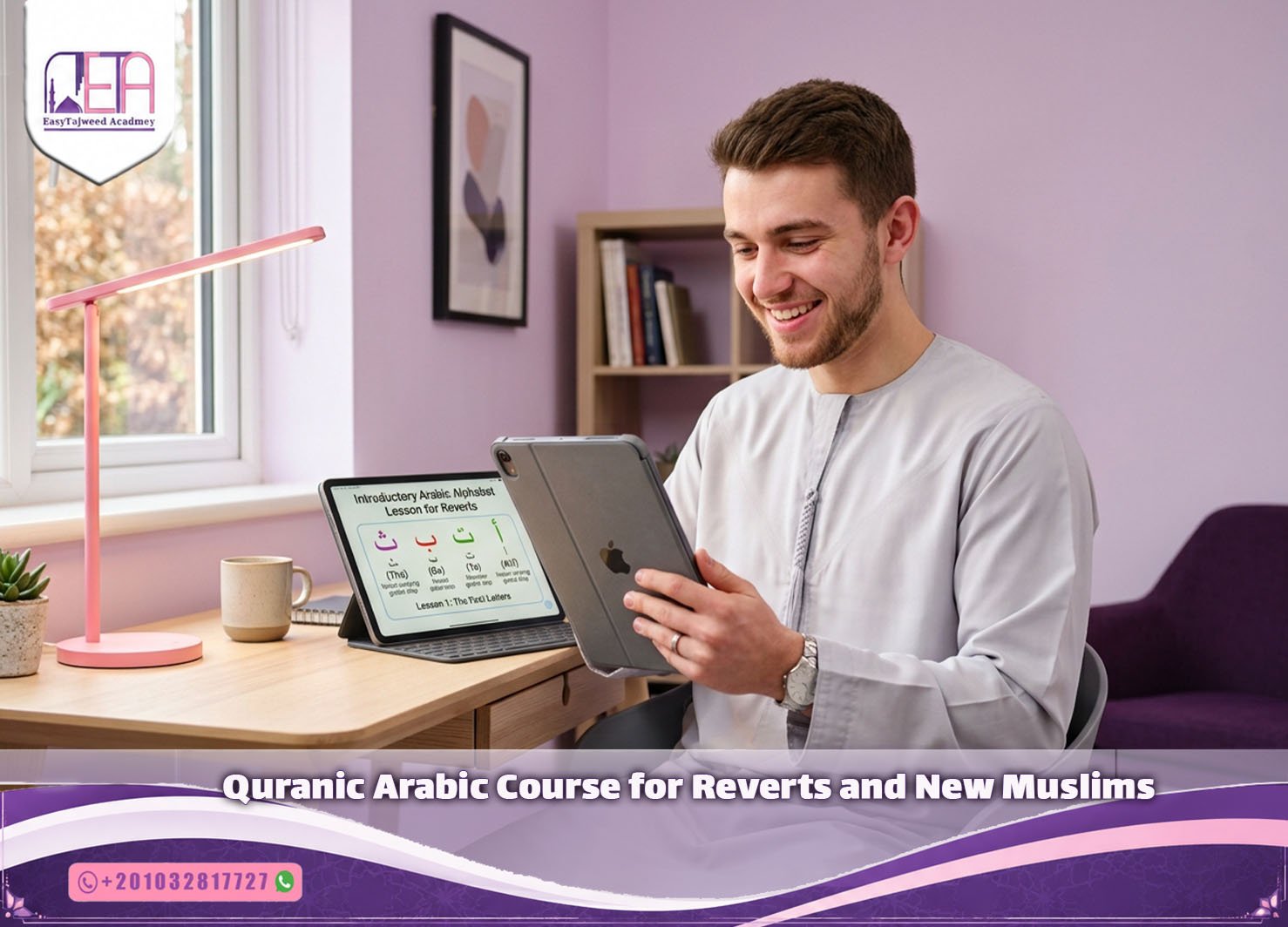
Quranic Arabic Course for Reverts and New Muslims
The Quranic Arabic Course for Reverts and New Muslims offers a structured, step-by-step online program to help beginners learn foundational Islamic knowledge, Quranic Arabic, Tajweed, and the Muslim lifestyle.
Institutions like Easy Tajweed Academy offer such courses to guide reverts in understanding the Qur’an with proper pronunciation and meaning, fostering spiritual growth and confidence in practicing Islam.
New Muslims may have a particularly strong desire to understand the Quran directly.
However, they can also feel overwhelmed by unfamiliar Arabic terminology and Islamic studies.
A beginner-friendly Quranic Arabic course can provide a gradual introduction without assuming that students already understand Arabic grammar or Islamic terminology.
Lessons can begin with essential Quranic vocabulary and gradually introduce grammar and sentence structure.
For reverts in Western countries, online learning is especially convenient because lessons can be scheduled around work, family, and other responsibilities.
A supportive teacher can also answer questions and explain concepts in English when necessary.
Quranic Arabic Course for Adults
Adults have different learning needs from children.
They may have demanding jobs, families, university studies, or irregular schedules.
For this reason, flexibility is one of the most important features of an online Quranic Arabic course.
One-to-one Quranic Arabic lessons can be particularly useful because the Quran teacher can adjust the pace according to the student’s ability.
A student who learns quickly can move forward, while someone who needs additional practice can spend more time reviewing difficult concepts.
Adults may also benefit from lessons that connect Arabic directly with the Quran rather than requiring them to spend months studying unrelated conversational topics.
Quranic Arabic Course for Children
Children can also benefit from learning Quranic Arabic, particularly when lessons are engaging and age-appropriate.
Instead of presenting long grammar explanations, teachers can introduce vocabulary through repetition, stories, Quranic examples, activities, and simple exercises.
Parents in the US, UK, Canada, and Australia look for online Islamic education that combines Quran reading with broader understanding.
A structured Quranic Arabic course can complement Quran reading and Tajweed lessons by helping children understand some of the words they recite.
The goal should not be to overwhelm young learners but to create positive associations with Arabic and the Quran.
Why Choose an Online Quranic Arabic Course?
Online education has transformed access to Islamic learning.
Students who live far from Islamic centers or qualified Arabic teachers can now attend lessons from home.
A modern Quranic Arabic course may offer several advantages.
Flexible Scheduling in an Online Quranic Arabic Course
Online Quranic Arabic lessons can be arranged around school, work, and family commitments.
This is especially valuable for families living in Western countries where Islamic educational programs may not always operate at convenient times.
One-to-One Online Quranic Arabic Course
Private Quranic Arabic classes allow teachers to focus directly on an individual student’s needs.
The teacher can identify weaknesses, review difficult concepts, and adjust the lesson pace.
Learning From Home
Students can attend classes without commuting.
This makes online Quranic Arabic particularly convenient for parents and busy professionals.
Access to Qualified Teachers
Online education gives students access to teachers who may live in different countries.
This can expand the range of instructors available to learners.
How Easy Tajweed Academy Supports Quranic Arabic Learning
Easy Tajweed Academy can be a useful option for students searching for structured online Quran and Arabic education.
The academy’s educational approach can support learners who want to improve their Quran reading while developing a stronger understanding of Arabic.
For students beginning their journey, a Quranic Arabic course can be combined with Quran reading and Tajweed education to create a more complete learning experience.
This combination is valuable because understanding Arabic and reading the Quran correctly are related but distinct skills.
A student may understand vocabulary but still need to improve pronunciation and Tajweed. Another student may recite beautifully but understand very little of what they are reading.
Combining these areas allows learners to work toward both accurate recitation and deeper comprehension.
How to Choose the Right Quranic Arabic Course
Choosing an online program requires more than looking at the course title.
Consider the following factors before enrolling.
1. Beginner-Friendly Curriculum
If you are starting from zero, make sure the course does not assume advanced Arabic knowledge.
The curriculum should introduce concepts progressively.
2. Qualified Teachers
Teachers should understand Arabic grammar and Quranic language and should be capable of explaining difficult concepts clearly.
Teaching ability is just as important as subject knowledge.
3. Flexible Lesson Times
For Western learners, scheduling matters.
Look for a program that can accommodate different time zones and personal routines.
4. Personalized Learning
A fixed curriculum can be useful, but students often progress at different speeds.
Personalized lessons allow teachers to address individual needs.
5. Practical Quranic Examples
The best learning experience connects language concepts to actual Quranic verses.
This makes lessons more relevant and memorable.
6. Progress Tracking
Students should be able to understand what they have learned and what they need to study next.
Regular revision and progress assessments can help maintain motivation.
Quranic Arabic vs. General Arabic
A common question is whether students should study general Arabic or focus specifically on Quranic Arabic.
The answer depends on the learner’s goals.
If your primary objective is understanding Quranic verses, a specialized Quranic Arabic course can provide a more focused path.
General Arabic programs may cover conversational language, modern vocabulary, everyday expressions, and Modern Standard Arabic.
These skills are valuable, particularly for students who want to communicate in Arabic.
However, a Quranic Arabic course places greater emphasis on the vocabulary, grammar, structures, and expressions needed to understand the Quran.
Students who want both Quran comprehension and everyday Arabic communication may eventually choose to study both.
How Long Does It Take to Learn Quranic Arabic?
There is no single answer because learning speed depends on several factors.
These include:
- Previous Arabic experience
- Study frequency
- Lesson quality
- Personal learning ability
- Vocabulary retention
- Practice outside lessons
- Understanding of grammar
- Consistency
A student who attends one lesson each week and rarely practices will naturally progress differently from someone who studies regularly and reviews vocabulary every day.
The goal should therefore be consistent progress rather than an unrealistic deadline.
With regular study in a Quranic Arabic course, beginners can gradually recognize common words and simple structures.
As their vocabulary and grammar knowledge develop, they can move toward more independent Quran comprehension.
How to Study Quranic Arabic Effectively
Enrolling in a Quranic Arabic course is only the beginning.
Students should also develop consistent study habits.
Review Frequently
Short, regular revision is often more effective than occasional long study sessions.
Review previously learned vocabulary before introducing large amounts of new material.
Read Quranic Verses
Try to identify familiar words in the Quran.
Even recognizing one or two words in a verse can reinforce what you learned.
Keep a Vocabulary Journal
Write down new words, meanings, roots, and example verses.
Digital notes can also work well.
Practice With Your Teacher
Do not be afraid to ask questions.
If a grammatical concept is confusing, ask the teacher to explain it using a simpler example.
Be Patient
Language learning takes time.
There will be moments when progress seems slow, but regular exposure gradually builds familiarity.
Common Mistakes Beginners Should Avoid
Several mistakes can slow down progress.
Trying to Learn Everything at Once
Arabic contains a huge amount of vocabulary and grammar.
Beginners should focus on essential concepts rather than attempting to master everything immediately.
Memorizing Without Context
Memorizing vocabulary is useful, but understanding how words function in Quranic verses is even more valuable.
Ignoring Revision
New information is easily forgotten without repetition.
Regular review should be part of every student’s study plan.
Comparing Your Progress With Others
Every learner has a different background and learning pace.
Focus on your own improvement.
Expecting Instant Fluency
A Quranic Arabic learner does not need to become a fluent Arabic speaker to begin benefiting from Quranic study.
The initial goal can simply be understanding increasingly more of what you read.
Frequently Asked Questions About Quranic Arabic
Is Quranic Arabic the same as Modern Standard Arabic?
They are closely related, but they are not identical in purpose and usage. Quranic Arabic refers specifically to the language of the Quran, while Modern Standard Arabic is used in contemporary formal communication, writing, media, and education.
Can I learn Quranic Arabic without speaking Arabic?
Yes. Speaking conversational Arabic is not a prerequisite.
A beginner-focused Quranic Arabic course can teach you the vocabulary and grammar needed to understand Quranic texts even if you have never spoken Arabic.
Can I learn Quranic Arabic online?
Yes. Online Quranic Arabic classes are now a practical option for learners around the world.
Students can study from home with teachers through live lessons, making online learning particularly convenient for Muslims living in Western countries.
Is Quranic Arabic suitable for children?
Yes, provided the teaching method is appropriate for the child’s age.
Children generally benefit from short, engaging lessons with repetition, visual materials, simple examples, and positive encouragement.
Should I learn Tajweed and Quranic Arabic together?
They can complement one another.
Tajweed focuses on correct Quran recitation, pronunciation, and reading rules, while Quranic Arabic focuses on understanding the language and its meaning.
Studying both in a Quranic Arabic course can provide a more complete Quran learning experience.
Is Quranic Arabic difficult?
Some aspects can be challenging at first, especially for students unfamiliar with Arabic.
However, a structured curriculum in a Quranic Arabic course, a qualified teacher, regular practice, and patience can make the learning process much more manageable

A Simple Learning Plan for Beginners
If you are unsure where to start, consider this gradual approach:
Stage 1: Build the foundation
Learn the Arabic alphabet, pronunciation, basic vocabulary, and essential Quranic terms.
Stage 2: Expand vocabulary
Study frequently occurring Quranic words and begin recognizing them in different verses.
Stage 3: Learn basic grammar
Study nouns, verbs, pronouns, prepositions, sentence structures, and simple grammatical relationships.
Stage 4: Explore word roots
Begin identifying Arabic roots and related word patterns.
Stage 5: Read with understanding
Apply what you have learned to short surahs and familiar Quranic passages.
Stage 6: Continue developing
Gradually study more advanced grammar, morphology, vocabulary, and Tafsir-related language.
This gradual approach keeps the learning process manageable and gives students measurable milestones.
Start Your Quranic Arabic Journey
Understanding the Quran in its original language is a meaningful goal for Muslims of all ages and backgrounds.
Whether you are a parent seeking Islamic education for your children, an adult hoping to understand the Quran more deeply, or a new Muslim beginning to explore Islam, Arabic study can open a new dimension of your relationship with the Quran.
A structured Quranic Arabic course provides a practical pathway from recognizing individual words to understanding sentences and eventually engaging with Quranic passages more independently.
The key is not to rush. Start with the basics, practice consistently, review what you learn, and work with teachers who can explain Arabic in a clear and supportive way.
For learners looking for an online environment that brings together Quran education, Tajweed, and Arabic learning, Easy Tajweed Academy offers a convenient platform to explore these areas with structured instruction.
Your journey does not need to begin with advanced grammar or hundreds of vocabulary words.
It can begin with one word.
Then one verse.
Then one surah.
With consistent learning, those small steps can gradually help you understand more of the Quran directly in the language in which it was revealed.
