

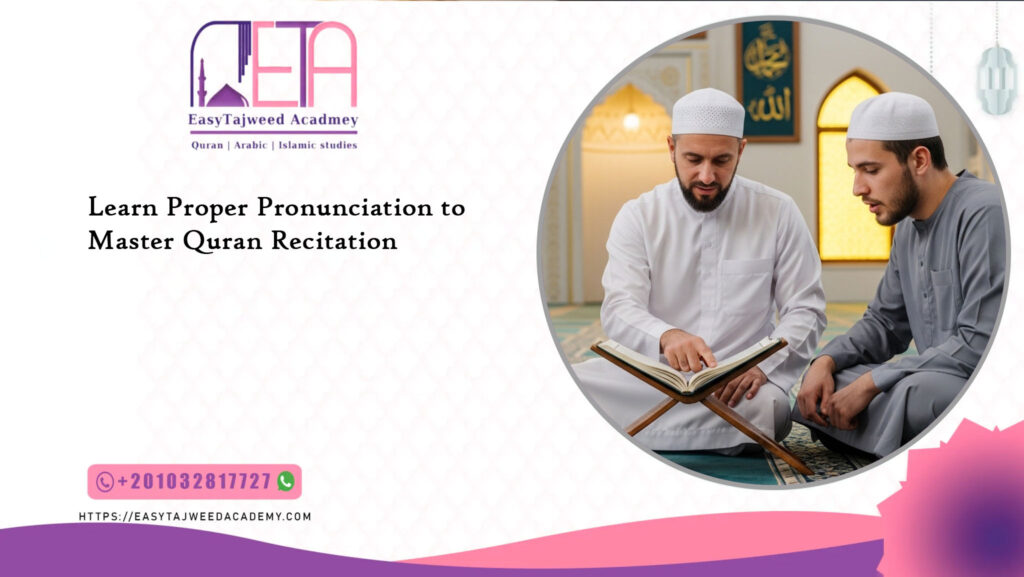
Mastering Quran recitation requires learning Tajweed (proper articulation and rules) to pronounce Arabic letters accurately from their designated points (Makharij). Key steps include studying under a qualified teacher, listening to expert reciters, consistent daily practice, and mastering letter characteristics (Sifaat) to avoid changing word meanings.
Learning the proper pronunciation of the Holy Quran is not just about reading words correctly; it is a spiritual and intellectual journey that connects the heart, tongue, and mind. Every letter in the Qur’an carries meaning, depth, and divine precision, and mastering quran pronunciation ensures that this message is preserved and conveyed as intended. For every Muslim, whether a child, beginner, or advanced learner, the ability to recite the Quran with Tajweed and correct pronunciation is a goal that brings both reward and fulfillment.
Mastering Quran recitation requires precise pronunciation through Tajweed, which governs the correct articulation of Arabic letters and sounds. Understanding Tajweed rules ensures accuracy in vocalization, intonation, and rhythm. A qualified male or female Quran teacher provides personalized feedback, while audio and visual resources help reinforce proper techniques. Consistent practice with focus on phonetics builds confidence and spiritual connection.
Platforms like the Leading platform Easy Tajweed Academy offer structured, interactive, and flexible online Quran classes designed for kids, adults, and beginners. These programs provide proper guidance, expert teachers, and personalized lessons to help students learn to pronounce Arabic letters correctly and achieve excellence in Quran recitation.
This comprehensive guide will walk you through everything you need to know about mastering proper pronunciation, from the basics of Tajweed rules to advanced techniques that enhance your recitation skills. Discover the Proper pronunciation of the Quran and enhance your recitation skills, and learn how to pronounce the Quran online with expert guidance and practical tips.
What Is Proper Pronunciation in Quran Recitation?
Proper pronunciation in Quran recitation refers to the accurate articulation of each Arabic letter from its correct origin, along with observing all Tajweed rules. The Holy Quran was revealed in Arabic, and every sound, vowel, and pause has significance. Even a small mistake in pronouncing a letter can change the meaning entirely, which is why learning correct pronunciation is essential.
When students begin learning the Quran, they often focus on reading fluently. However, fluency without proper Tajweed may lead to errors. Proper pronunciation ensures that every letter is given its due right, maintaining the beauty and authenticity of the recitation. It also protects the integrity of the holy text, preserving it as it was revealed. For further reading, take a look at Reading the Quran online. This connects well with Quran reading course.
For beginners, the journey starts with recognizing Arabic letters and learning how to pronounce them correctly. With consistent practice, structured lessons, and expert guidance, students gradually improve their ability to recite the Quran with clarity and confidence. For further reading, take a look at Master Quranic Arabic with online lessons. This connects well with Virtual Quran classes.
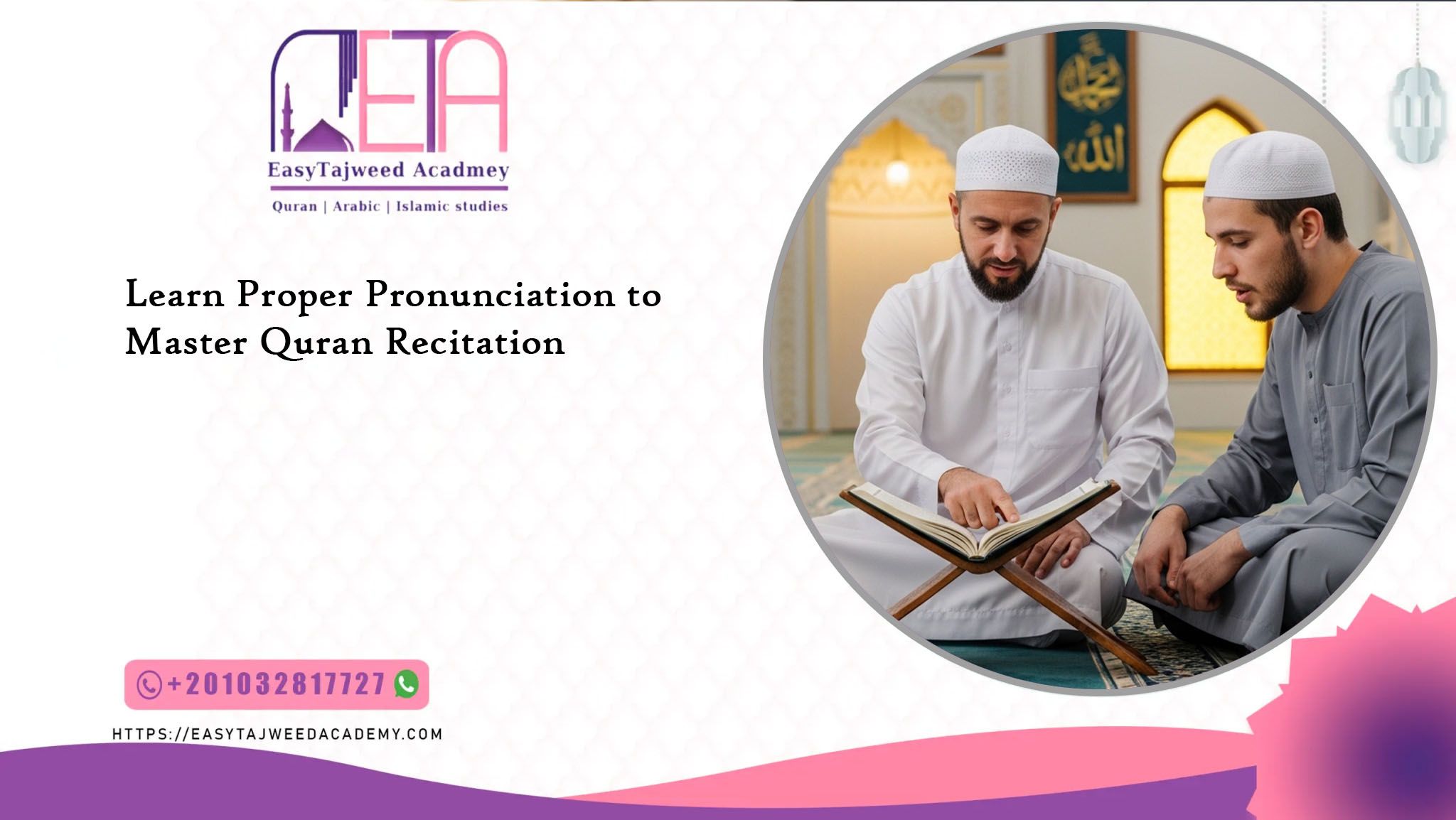
Understanding the Basics of Tajweed Rules
Tajweed is the science that governs the rules of Quran recitation, ensuring that every word is recited with proper pronunciation and rhythm. These rules are not optional; they are essential for anyone who wants to recite the Quran correctly. For more on this, take a look at our Quran recitation course. You can also explore Tajweed Ijazah course for additional guidance.
At its core, Tajweed focuses on how letters interact with each other, how long sounds should be held, and where pauses should occur. For example, elongation rules, nasal sounds, and stopping points all contribute to the overall beauty of the recitation. Learning these basic principles helps students avoid common mistakes and develop a strong foundation. Related reading: check out Best online Tajweed classes. If you’re interested, take a look at Quran with Tajweed.
Many online Quran courses use colour-coded systems to make Tajweed rules easier to understand. These visual aids help learners identify where to stretch a sound, apply nasalization, or emphasize a letter. This approach is especially effective for children and beginners, making the learning process more engaging and interactive.
By understanding Tajweed, students not only improve their pronunciation of Tajweed but also enhance their connection with the Quran, as they begin to appreciate the rhythm and flow of its verses.
The Role of Makharij (Articulation Points) in Quran Recitation
One of the most important aspects of proper pronunciation is understanding Makharij, or the articulation points of Arabic letters. Each letter in the Arabic language originates from a specific place in the mouth or throat, and identifying these points is crucial for accurate recitation. Worth a look: Tajweed lessons online. See also Tajweed for more details.
For instance, some letters come from the throat, while others are pronounced using the tongue, lips, or nasal cavity. Without mastering these articulation points, it becomes difficult to achieve correct pronunciation. This is why expert teachers place strong emphasis on teaching Makharij during the early stages of learning the Quran. Related reading: check out Fiqh classes online. If you’re interested, take a look at Quran recitation techniques.
Practicing Makharij involves repetition and careful listening. Students are encouraged to mimic their teachers and focus on producing each sound correctly. Over time, this practice strengthens their ability to pronounce letters naturally and effortlessly.
In online Quran learning, teachers often use audio tools and live sessions to demonstrate articulation clearly. This ensures that students receive proper guidance, even in a virtual environment, and can confidently recite the Quran with proper pronunciation.
How Proper Pronunciation Improves Your Tajweed Skills
Mastering proper pronunciation significantly enhances your Tajweed skills. When each letter is pronounced correctly, it becomes easier to apply the rules of Tajweed accurately. This creates a smooth and harmonious recitation that reflects the true essence of the Holy Quran. Worth a look: Learn Tajweed online. See also Recitation of Quran for more details.
Proper pronunciation also builds confidence. Students who can read and recite with clarity feel more comfortable participating in group recitations and leading prayers. It transforms the learning experience from a struggle into a rewarding journey.
Moreover, correct pronunciation helps prevent errors that could alter meanings. This is especially important when striving for a deeper understanding of the Quran. By focusing on pronunciation, learners develop a stronger connection with the text and gain insight into its message.
Consistent practice, combined with structured lessons, allows students to gradually refine their skills. Whether through online classes or in-person teaching, the goal remains the same: to achieve recitation with proper accuracy and beauty. This connects well with Online Tajweed course.
Step-by-Step Guide to Achieving Proper Pronunciation in Quran Recitation
Achieving proper pronunciation requires a clear and structured approach. The first step is to learn the Arabic alphabet and understand how each letter is pronounced. This forms the foundation for all future learning. For more on this, take a look at our Arabic tutor. You can also explore Quran academy for additional guidance.
The next step involves practicing Makharij, focusing on the correct articulation of each sound. Students should listen carefully to their teachers and repeat after them, ensuring that they pronounce each letter correctly. This stage may take time, but it is essential for building accuracy.
Once the basics are mastered, learners move on to applying Tajweed rules. This includes understanding elongation, pauses, and emphasis. Using colour-coded Quran texts can make this process easier and more accessible.
Regular practice is key. Students should dedicate time each day to reading and reciting the Quran. Recording their recitation and comparing it with expert readings can also help identify areas for improvement.
Finally, seeking proper guidance from qualified teachers ensures continuous progress. Whether through online Quran courses or traditional classes, expert instruction provides the support needed to master proper pronunciation.
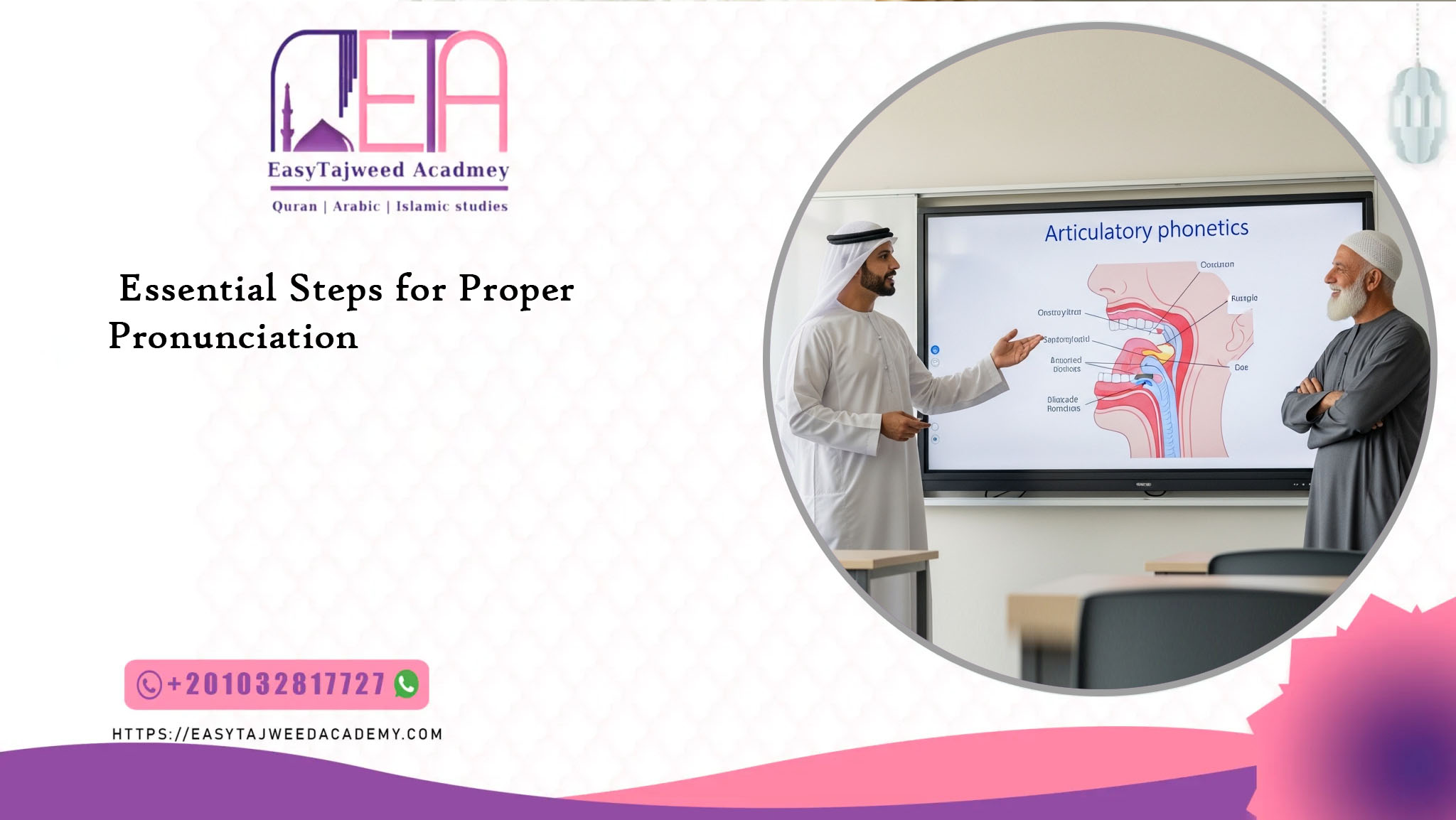
Essential Steps for Proper Pronunciation
Proper pronunciation is essential for effective communication, as it ensures you are understood and increases your confidence when speaking. Mastering it involves training your ears to hear new sounds and your mouth muscles to produce them.
Here are the essential steps to improve pronunciation:
Active Listening
- Listen before you speak: Actively listen to native speakers to identify sounds, stress, and intonation.
- Use authentic content: Watch movies, TV shows, and YouTube videos, or listen to podcasts and audiobooks to hear natural speech patterns.
- Shadowing technique: Listen to a short audio clip and repeat it immediately, acting as an “echo” to mimic the rhythm and intonation.
Master Specific Sounds (Phonetics)
- Focus on phonemes: Study the specific vowel and consonant sounds of the language.
- Use a mirror: Observe your mouth, tongue, and lip positions in a mirror to ensure you are creating sounds correctly.
- Practice minimal pairs: Focus on words that differ by only one sound (e.g., “ship” vs. “sheep” or “pat” vs. “bat”) to train your ear and mouth.
Focus on Stress and Rhythm
- Word Stress: Learn which syllable to emphasize within a word (e.g., pho-to-graph vs. pho-tog-ra-pher).
- Sentence Stress: Understand which words in a sentence receive more emphasis, typically content words (nouns, verbs, adjectives) rather than function words (prepositions, articles).
- Rhythm: English is a stress-timed language, meaning stressed syllables occur at regular intervals.
Record and Evaluate
- Record yourself: Use your phone to record your voice while Quran reading or speaking, then compare it to a native speaker.
- Identify gaps: Listen for where your pronunciation differs from that of the native speaker, focusing on specific sounds or stress issues.
- Narrate your life: Describe what you are doing out loud to practice spontaneously.
Practice Connected Speech
- Join words together: Learn how native speakers link words together (e.g., “not at all” sounds like “notatall”).
- Learn reductions: Understand how unstressed words and syllables are shortened or reduced (e.g., “to” becomes /tə/).
Practice Regularly
- Consistency over intensity: Even 10-15 minutes of focused daily practice is more effective than long, infrequent sessions.
- Use tongue twisters: These are excellent for exercising mouth muscles and improving articulation.
- Get feedback: Use AI-powered pronunciation apps, or work with a tutor, language partner, or friend who can correct your mistakes
The Role of Proper Pronunciation in Understanding Quranic Meaning
Proper pronunciation is not just about sound; it plays a vital role in the understanding of the Quran. Each word in the Qur’an carries meaning, and incorrect pronunciation can lead to misunderstandings.
When students learn to recite the Quran correctly, they become more aware of the structure and rhythm of the language. This awareness enhances their ability to comprehend the message and reflect on its teachings.
Additionally, Tajweed helps highlight important aspects of the text, such as emphasis and pauses. These elements guide the reader in understanding the context and flow of the verses.
By combining correct pronunciation with study and reflection, learners develop a deeper connection with the Holy Quran. This connection transforms recitation into a meaningful and spiritual experience.
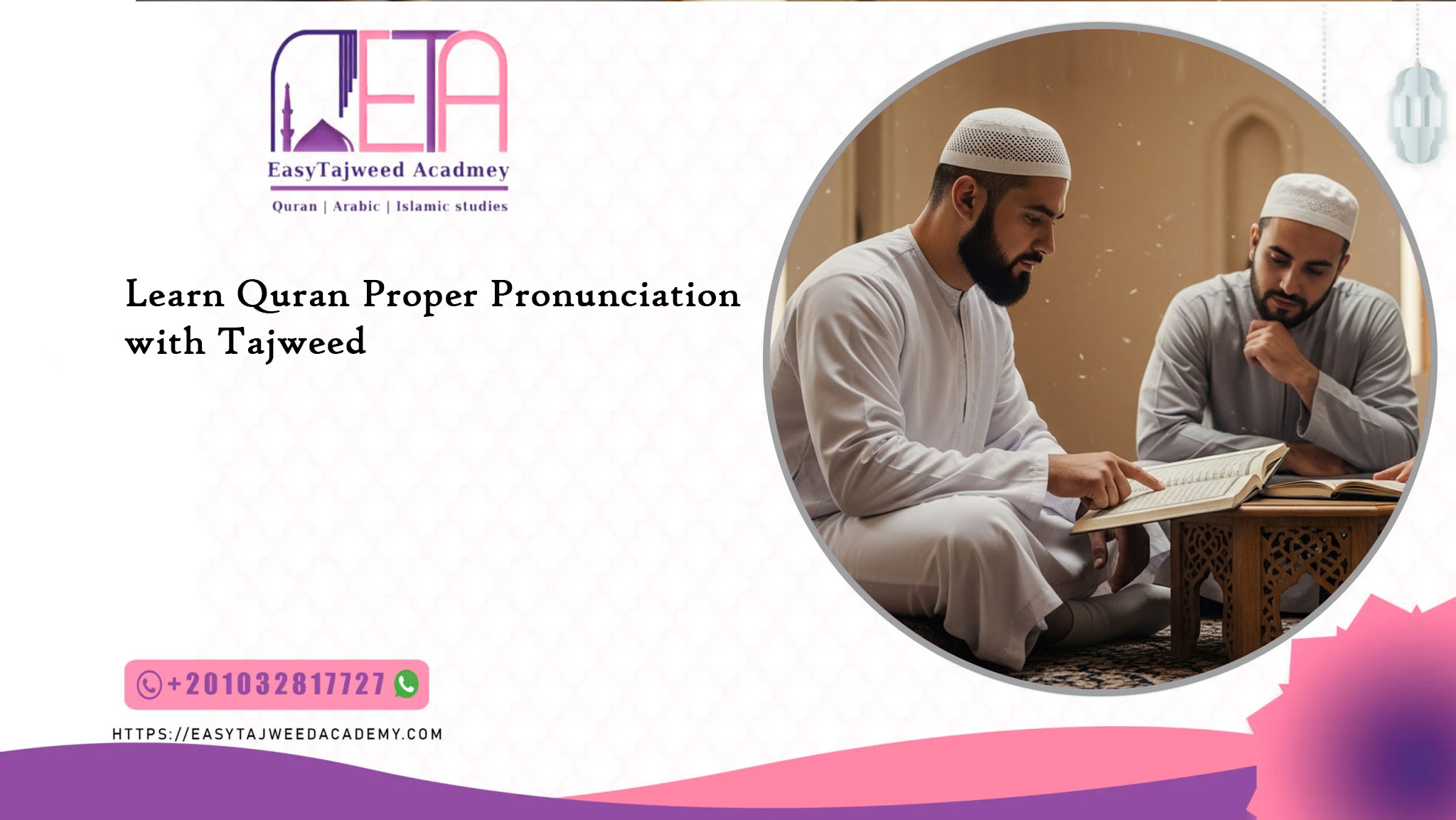
Learn Quran Proper Pronunciation with Tajweed
Learning the Quran with Tajweed is the most effective way to achieve proper pronunciation. Tajweed provides a structured system that ensures every letter and sound is recited correctly.
Modern online Quran learning platforms offer a variety of courses designed for different levels. These programs are flexible, allowing students to learn at their own pace while receiving personalized guidance.
Interactive lessons, audio tools, and live sessions make it easier to understand complex concepts. Students can practice in real time, receive feedback, and continuously improve their recitation skills.
Whether you are a beginner or an advanced learner, enrolling in a Quran recitation online course for kids or adults can significantly enhance your ability to recite the Quran with proper Tajweed. For further reading, take a look at Online Quran classes for adults.
Proper Pronunciation of the Quran with Easy Tajweed Academy
The Leading platform, Easy Tajweed Academy, stands out as a trusted source for online Quran education. It offers structured, interactive, and easy-to-follow programs that focus on proper pronunciation and Tajweed.
With qualified teachers and a well-designed curriculum, the academy ensures that students receive the best possible guidance. Lessons are tailored to meet individual needs, making them suitable for children, adults, and beginners alike.
The academy also provides flexible timings, allowing students to balance their studies with other commitments. This accessibility makes it easier for learners worldwide to start their journey in learning the Quran.
Through consistent practice and expert instruction, students can develop strong recitation skills and achieve excellence in Quran pronunciation.
Master Quran Recitation Proper Pronunciation with Experts
Mastering Quran recitation requires dedication, practice, and the support of expert teachers. Learning from experienced instructors ensures that students receive accurate feedback and continuous improvement.
Experts help identify mistakes, refine pronunciation, and guide learners through advanced Tajweed rules. Their teaching methods are often interactive and engaging, making the learning process enjoyable and effective.
By enrolling in professional online Quran courses, students gain access to a wealth of resources, including recorded lessons, live sessions, and personalized feedback. This comprehensive approach ensures steady progress and long-term success.
Ultimately, mastering proper pronunciation is a journey that requires patience and commitment. With the right guidance, structured learning, and consistent practice, anyone can achieve the ability to recite the Quran beautifully and accurately.
Mastering proper pronunciation is more than a technical skill; it is a path to spiritual growth and a deeper connection with the Holy Quran. Whether you are just starting or looking to enhance your skills, the journey is both rewarding and transformative. By embracing Tajweed, seeking expert guidance, and committing to regular practice, you can unlock the true beauty of Quran recitation and carry its message with clarity and confidence.
………………FAQ………………..
What does proper pronunciation mean in Quran recitation?
Proper pronunciation in Quran recitation means articulating each Arabic letter correctly from its origin (makhraj) and applying Tajweed rules to preserve the meaning and beauty of the Quranic words.
Why is proper pronunciation important when reciting the Quran?
Proper pronunciation ensures the Quran is recited as it was revealed, maintaining the correct meaning and avoiding errors that could alter the message of Allah.
How can I learn proper pronunciation for Quran recitation?
You can learn proper pronunciation by studying Tajweed rules, listening to expert reciters, and enrolling in online Quran recitation courses with qualified teachers.
Can beginners master Quran pronunciation easily?
Yes, beginners can master Quran pronunciation with consistent practice, proper guidance, and learning step-by-step under a skilled Quran tutor.
What are the main rules of Tajweed for proper pronunciation?
Key Tajweed rules include understanding Makharij (articulation points), Sifaat (characteristics of letters), Ghunnah (nasal sounds), and rules of Madd (elongation).
How long does it take to achieve proper Quran pronunciation?
The time varies by learner, but with regular practice and feedback from a teacher, noticeable improvement can occur within a few months.
Do I need to know Arabic to master Quran pronunciation?
While understanding Arabic helps, it’s not required. Many non-Arabic speakers achieve excellent pronunciation by learning Tajweed phonetics and practicing regularly.
What mistakes should I avoid in Quran pronunciation?
Common mistakes include mispronouncing letters, skipping elongations (Madd), or failing to observe pauses and stops correctly. A teacher can help correct these errors.
Can online classes help improve my Quran pronunciation?
Yes, online Quran classes with qualified teachers provide personalized lessons, pronunciation correction, and continuous feedback to enhance your recitation skills.
How can I practice proper Quran pronunciation daily?
Listen to expert reciters, repeat after them, record your recitation, and review Tajweed lessons daily for consistent improvement.
What is our goal when we seek correct Quran recitation?
We aim to preserve the revealed message exactly as taught to Prophet Muhammad, using clear articulation and the established set of tajweed rules, so meanings remain intact and the beauty of the text shines.
Why does accurate articulation matter for meaning?
Small changes in letters, elongation, or nasal sounds can alter a word or verse. We follow precise makharij and sifat to prevent shifts in meaning and to honor the text’s integrity.
How do we begin moving from the Arabic alphabet to fluent recitation?
We start with letter shapes, sounds, and mouth positions, then add one tajweed rule at a time. Daily measured practice and listening to qualified reciters speed our progress.
What are the most essential Tajweed rules we should apply first?
We focus on makharij (points of articulation), sifaat (characteristics), noon sakinah and tanween rules, madd (elongation), and qalqalah. These build a solid base for correct read-throughs.
How do makharij and sifaat help our recitation?
Makharij teaches where each letter emerges in the mouth and throat. Sifaat describes traits like strength or softness. Together they shape each sound for accurate, expressive recitation.
What steps do we follow to master Tajweed progressively?
We begin with the alphabet, practice individual sounds, learn one rule set at a time, read aloud daily with tarteel pacing, and record ourselves for feedback and refinement.
How should we structure practice time for steady improvement?
We set short daily blocks, pick specific verses or surahs, repeat critical sections, and track milestones. Consistency beatlongon,g infrequent sessions for lasting gains.
