

Ghunnah in Tajweed refers to the nasal sound produced during certain letters (like ن, م, ء, و, ي) when they are elongated. There are two main types: ghunnah mutaqaribah (short ghunnah), a brief nasalization lasting one beat, and ghunnah muntasibah (long ghunnah), which lasts two beats and occurs when the letter is followed by sukun or a pause. Ghunnah in Tajweed is essential for proper recitation, ensuring clarity and adherence to Quranic pronunciation rules.
Learning Ghunnah in Tajweed is an essential step toward improving Quran recitation and pronouncing Arabic letters correctly. Ghunnah is the natural nasal sound associated with two Arabic letters: Noon (ن) and Meem (م). It plays an important role in several Tajweed rules, including Ikhfa, Idgham, and Iqlab.
For beginners, understanding Ghunnah in Tajweed can make Quran reading easier and more accurate. However, knowing when to produce this nasal sound and how long to hold it requires regular practice and proper guidance.
In this comprehensive guide, you will learn what Ghunnah in Tajweed means, where it is produced, which letters produce it, and the six situations in which a full two-count Ghunnah is required. You will also learn practical pronunciation techniques, explore Quranic examples, and identify common mistakes to avoid. Whether you are an adult learner, a parent helping your child, or a new Muslim, this guide will help you develop a stronger foundation in Tajweed.
What Is Ghunnah in Tajweed?
Ghunnah in Tajweed (غُنَّة) is a nasal sound produced through the nasal passage, known in Arabic as Al-Khayshum (الخَيْشُوم). It is an essential characteristic of the Arabic letters Noon (ن) and Meem (م), and it contributes to the correct pronunciation of several Quranic words.
The linguistic meaning of Ghunnah in Tajweed is a nasal or resonant sound. In Tajweed terminology, it refers to a distinctive sound that accompanies Noon and Meem and is produced through the nasal cavity.
Unlike ordinary vowel sounds, Ghunnah does not depend entirely on the movement of the tongue or lips. Its nasal resonance comes from the nasal passage. This is why learners must understand its articulation rather than simply imitate a sound.
For example, consider these Arabic expressions:
- إِنَّ (Inna): The Noon has a Shaddah, so it must be pronounced with a clear two-count Ghunnah.
- ثُمَّ (Thumma): The Meem has a Shaddah and requires the same nasal quality.
- مِنْ بَعْدِ (Min Ba’di): The Noon Sakinah changes into a concealed Meem sound because of Iqlab, accompanied by Ghunnah.
Ghunnah is important because it preserves the correct pronunciation and characteristics of Quranic words. Applying it properly also helps distinguish between different Tajweed rules.
Ghunnah is not a separate fifth rule of Noon Sakinah and Tanween. Instead, it is a sound characteristic that appears in particular Tajweed situations.
What Are the Letters of Ghunnah in Tajweed?
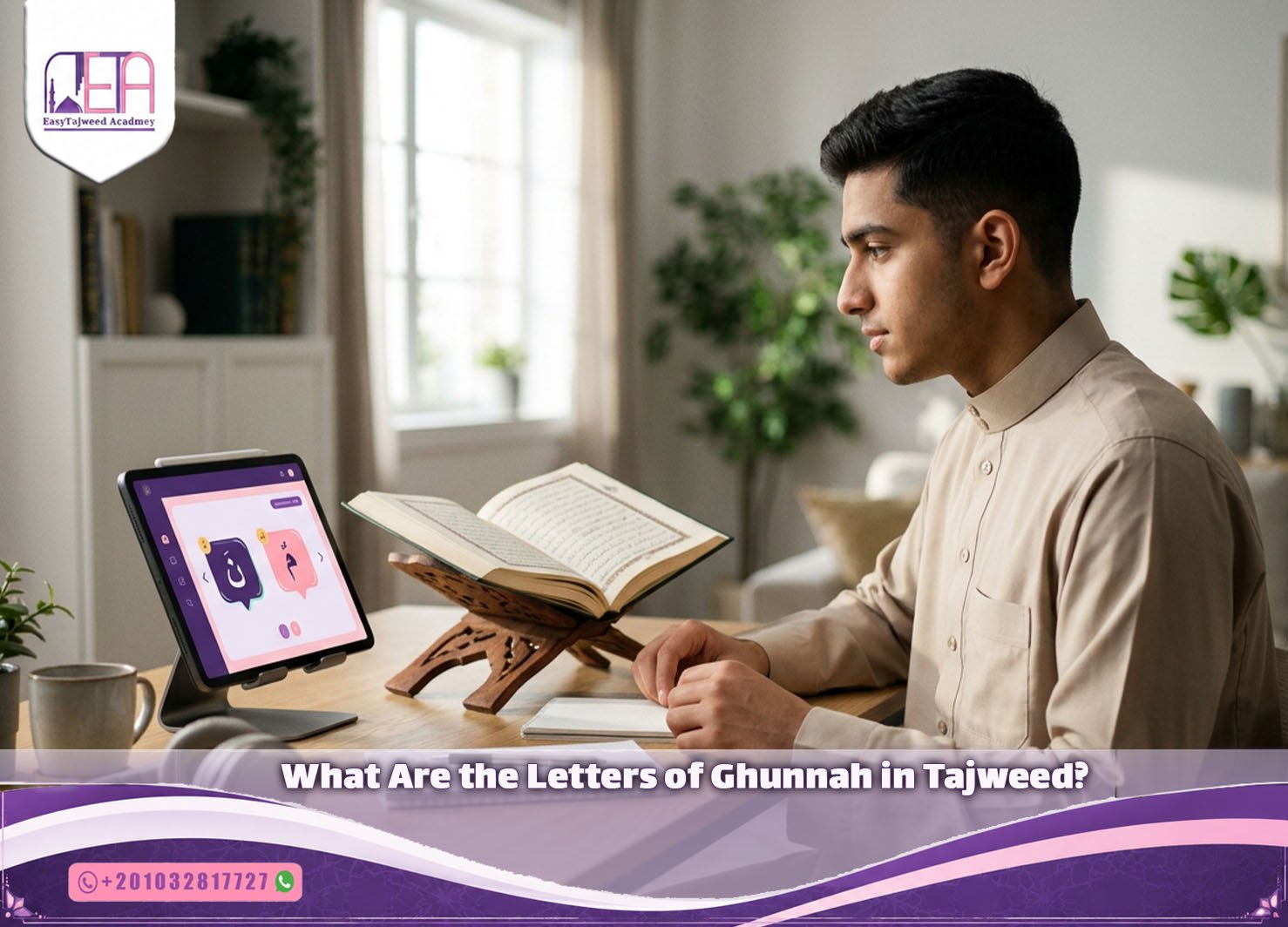
The two letters associated with Ghunnah are Noon (ن) and Meem (م). Both letters naturally carry a nasal quality, although they are pronounced differently.
Noon is produced with the tongue making contact with the area behind the upper front teeth, while Meem is produced by closing the lips. Despite these different articulation points, both letters share the nasal resonance that comes through Al-Khayshum.
1. Noon (ن)
Noon is one of the most important letters in Tajweed because it appears in several rules, including Izhar, Idgham, Iqlab, and Ikhfa.
When Noon carries a Shaddah, as in إِنَّ, it must be pronounced with a complete two-count Ghunnah.
Noon Sakinah and Tanween can also produce Ghunnah depending on the letter that follows them.
2. Meem (م)
Meem is the second letter associated with Ghunnah. Its articulation involves closing the lips while allowing the nasal sound to resonate.
For example, the word ثُمَّ contains a Meem Mushaddadah, which requires a full two-count Ghunnah.
Meem Sakinah also appears in two important rules involving Ghunnah: Ikhfa Shafawi and Idgham Shafawi.
What Is the Relationship Between Ghunnah and Tanween?
Tanween is a double vowel marking that produces an additional Noon sound at the end of a word. Its pronunciation changes according to the following letter.
For example, Tanween may be pronounced clearly in Izhar, merged with a nasal sound in Idgham with Ghunnah, concealed in Ikhfa, or changed into a hidden Meem sound in Iqlab.
Therefore, understanding the two letters of Ghunnah helps Quran learners recognize its application in different recitation situations.
Where Does Ghunnah Come From? (Makhraj of Ghunnah)
In Tajweed, Makhraj refers to the articulation point from which an Arabic letter or sound originates. Understanding the Makhraj of Ghunnah helps learners produce its nasal quality correctly.
Ghunnah in Tajweed comes from Al-Khayshum (الخيشوم), which refers to the nasal passage or nasal cavity. It is the articulation point responsible for the nasal resonance associated with Noon and Meem.
Although Noon and Meem have different primary articulation points, their Ghunnah comes from the same nasal passage.
- Noon (ن): Its primary articulation involves the tongue and the upper gum area behind the front teeth.
- Meem (م): Its primary articulation involves the closing of the two lips.
- Ghunnah: Its nasal resonance comes through Al-Khayshum.
How Can You Recognize the Nasal Sound?
A simple exercise can help beginners recognize Ghunnah.
First, gently pronounce the letter Meem while keeping your lips closed. Allow the sound to resonate naturally through your nose. Then try the same exercise with Noon.
You can also gently close your nostrils while producing a sustained nasal sound. You should notice that the nasal resonance changes or becomes restricted.
Do not use this exercise to force the sound or replace correct articulation. Its purpose is simply to help you recognize the role of the nasal passage.
How Long Should You Hold Ghunnah in Tajweed?
In the main Tajweed situations requiring a complete Ghunnah, the nasal sound is generally held for two Harakah (two counts).
A Harakah is a basic unit of timing in Quran recitation. It is approximately the time needed to pronounce a short vowel, such as the Fatha, Kasra, or Damma. Two Harakah means extending the sound for approximately twice that duration.
However, the exact pace depends on the overall speed of recitation. The important point is to maintain consistent timing rather than counting too quickly or stretching the sound unnecessarily.
For example:
- إِنَّ: Hold the Ghunnah on the Noon Mushaddadah for two counts.
- ثُمَّ: Hold the Ghunnah on the Meem Mushaddadah for two counts.
- مِنْ بَعْدِ: Apply a two-count nasal sound during Iqlab.
Why Is Correct Ghunnah Duration Important?
Holding Ghunnah in Tajweed for the correct duration helps preserve the characteristics of Quranic pronunciation.
Shortening it may weaken the required nasal quality, while extending it unnecessarily can affect the rhythm and accuracy of recitation.
Beginners should practise with a qualified Tajweed teacher and listen to reliable Quran reciters to develop consistent timing.
What Are the Main Rules of Ghunnah in Tajweed?
The main applications of full Ghunnah in Tajweed in this guide are Noon Mushaddadah, Meem Mushaddadah, Idgham with Ghunnah, Ikhfa Haqiqi, Iqlab, Ikhfa Shafawi, and Idgham Shafawi.
The two Mushaddadah cases are often taught together as one general category, giving six main applications or teaching groups.
These rules appear throughout the Quran. Understanding them helps learners recognize when to produce a complete nasal sound and how to apply it correctly.
1. Ghunnah in Noon and Meem Mushaddadah
Noon Mushaddadah and Meem Mushaddadah are among the clearest situations requiring Ghunnah.
A Mushaddadah letter is a letter carrying a Shaddah (ّ), which represents a doubled consonant. When Noon or Meem carries a Shaddah, the reader must hold its nasal sound for two counts.
Examples:
- إِنَّ: The Noon carries a Shaddah and requires two-count Ghunnah.
- النَّاسِ: The Noon Mushaddadah must be pronounced with Ghunnah.
- ثُمَّ: The Meem carries a Shaddah and requires a two-count Ghunnah.
The reader should not separate the nasal sound from the letter or pronounce it as an additional independent letter. Instead, maintain a smooth and balanced nasal resonance while pronouncing the Mushaddadah letter.
2. Ghunnah in Idgham with Ghunnah
Idgham with Ghunnah in Tajweed, also called Idgham Bi Ghunnah, occurs when Noon Sakinah or Tanween is followed by one of four letters:
ي، ن، م، و
These letters are commonly remembered through the Arabic word يَنْمُو (Yanmu).
In this rule, the Noon Sakinah or Tanween merges into the following letter while the reader maintains a two-count Ghunnah.
For example:
- مَنْ يَعْمَلْ: Noon Sakinah merges into the following Ya.
- مِنْ مَالٍ: Noon Sakinah merges into Meem.
- مِنْ وَالٍ: Noon Sakinah merges into Waw.
The sound should flow naturally into the following letter without producing a separate, clearly pronounced Noon.
An important exception concerns a Noon Sakinah followed by a Ya or Waw within the same word. In the standard Hafs narration, this is not treated as ordinary Idgham; it is pronounced with Izhar Mutlaq.
3. Ghunnah in Ikhfa Haqiqi
Ikhfa Haqiqi means concealing or partially hiding the Noon Sakinah or Tanween sound when one of the 15 Ikhfa letters follows it.
The 15 letters are:
ت، ث، ج، د، ذ، ز، س، ش، ص، ض، ط، ظ، ف، ق، ك
When this rule occurs, the Noon sound is neither pronounced with complete clarity nor fully merged into the next letter. Instead, it is concealed with a two-count Ghunnah.
For example:
- مِنْ قَبْلُ: Noon Sakinah is concealed before Qaf.
- أَنْفُسَكُمْ: Noon Sakinah is concealed before Fa.
The reader should prepare the tongue for the following letter while maintaining the nasal sound through Al-Khayshum.
4. Ghunnah in Iqlab
Iqlab means changing or converting a sound. It occurs when Noon Sakinah or Tanween is followed by the Arabic letter Ba (ب).
In this situation, the Noon sound changes into a hidden Meem sound accompanied by a two-count Ghunnah.
For example:
- مِنْ بَعْدِ: Noon Sakinah is changed into a hidden Meem sound before Ba.
- سَمِيعٌ بَصِيرٌ: Tanween is changed into a hidden Meem sound before Ba.
The lips should be prepared for the Ba sound without producing an exaggerated or fully independent Meem.
A small Meem sign may appear in the Mushaf to indicate Iqlab. Recognizing this sign helps learners identify the rule while reading.
5. Ghunnah in Ikhfa Shafawi
Ikhfa Shafawi is one of the rules of Meem Sakinah. It occurs when a Meem Sakinah (مْ) is followed by the letter Ba (ب).
The word Shafawi relates to the lips because Meem and Ba are both pronounced using the lips.
In this rule, the Meem Sakinah is concealed before Ba, and the reader produces a two-count Ghunnah.
For example:
تَرْمِيهِمْ بِحِجَارَةٍ
In this Quranic expression, the Meem Sakinah at the end of تَرْمِيهِمْ is followed by Ba in بِحِجَارَةٍ.
The reader should maintain a gentle nasal sound while preparing the lips for Ba. Avoid pressing the lips together too forcefully or separating the two sounds unnaturally.
6. Ghunnah in Idgham Shafawi
Idgham Shafawi occurs when Meem Sakinah is followed by another Meem carrying a vowel.
In this situation, the first Meem merges into the second Meem, producing a Mushaddadah Meem with a two-count Ghunnah.
For example:
لَهُمْ مَا يَشَاءُونَ
The Meem Sakinah at the end of لَهُمْ merges into the following Meem in مَا.
The reader should pronounce the resulting Meem smoothly while maintaining the required nasal sound.
This rule is sometimes called Idgham Mithlayn Saghir because two identical letters meet, with the first being Sakinah and the second carrying a vowel.
Quick Comparison of the Main Ghunnah Rules in Tajweed
| Tajweed rule | When it occurs | Ghunnah duration |
|---|---|---|
| Noon Mushaddadah | Noon with Shaddah | 2 counts |
| Meem Mushaddadah | Meem with Shaddah | 2 counts |
| Idgham with Ghunnah | Noon Sakinah or Tanween before ي، ن، م، و | 2 counts |
| Ikhfa Haqiqi | Noon Sakinah or Tanween before 15 Ikhfa letters | 2 counts |
| Iqlab | Noon Sakinah or Tanween before ب | 2 counts |
| Ikhfa Shafawi | Meem Sakinah before ب | 2 counts |
| Idgham Shafawi | Meem Sakinah before م | 2 counts |
These situations demonstrate how Ghunnah connects different Tajweed rules. Although the pronunciation changes depending on the following letter, the nasal quality remains an important part of accurate recitation.
Examples of Ghunnah in the Quran
Learning Ghunnah becomes easier when you recognize it in actual Quranic words and expressions. The following examples demonstrate how the nasal sound appears in different situations.
| Rule | Quranic example | What to notice |
|---|---|---|
| Noon Mushaddadah | إِنَّ | Two-count Ghunnah on Noon |
| Meem Mushaddadah | ثُمَّ | Two-count Ghunnah on Meem |
| Idgham with Ghunnah | مَنْ يَعْمَلْ | Noon merges into Ya |
| Ikhfa Haqiqi | مِنْ قَبْلُ | Concealed Noon before Qaf |
| Iqlab | مِنْ بَعْدِ | Hidden Meem sound before Ba |
| Ikhfa Shafawi | تَرْمِيهِمْ بِحِجَارَةٍ | Concealed Meem before Ba |
| Idgham Shafawi | لَهُمْ مَا يَشَاءُونَ | Meem merges into another Meem |
When practising these examples, focus on identifying the letter that triggers the rule. Then listen carefully to the nasal sound and maintain its correct duration.
It is also useful to read the examples slowly before attempting to recite them at a normal pace.
For more effective learning, use a reliable Mushaf with Tajweed colour markings. These markings can help you identify Ghunnah-related rules, although you should also learn the underlying principles rather than depending entirely on colours.
What Is the Difference Between Ghunnah and Other Tajweed Rules?
One common misunderstanding among beginners is treating Ghunnah as a separate ruling similar to Ikhfa or Idgham. In reality, Ghunnah is a nasal sound characteristic, while the other terms describe specific pronunciation rules.
Ghunnah and Ikhfa: Ikhfa is the concealment of Noon Sakinah, Tanween, or Meem Sakinah in particular situations. Ghunnah is the nasal sound that accompanies this concealment.
Ghunnah and Idgham: Idgham means merging one letter into another. When Idgham Bi Ghunnah occurs, the merging is accompanied by a nasal sound. However, not every type of Idgham requires Ghunnah.
Ghunnah and Izhar: Izhar means pronouncing a letter clearly without merging or concealing it. In Izhar of Noon Sakinah and Tanween, the Noon sound is pronounced clearly rather than being given the extended Ghunnah required in Ikhfa or Idgham Bi Ghunnah.
Ghunnah and Madd: Madd refers to elongating a vowel sound, whereas Ghunnah is a nasal resonance. Both may involve measured duration, but they are different pronunciation characteristics.
Understanding these distinctions prevents learners from applying the wrong rule while reading the Quran.
Common Mistakes to Avoid When Pronouncing Ghunnah
Although Ghunnah in Tajweed may seem simple, beginners often make mistakes that affect their Quran recitation. Recognizing these problems is the first step toward improving pronunciation.
1. Shortening the Ghunnah: Some learners pronounce Noon or Meem Mushaddadah too quickly. Remember that a complete Ghunnah in the relevant situations generally lasts two Harakah.
2. Stretching the sound excessively: Holding Ghunnah longer than required can disturb the natural rhythm of recitation. Aim for consistent two-count timing.
3. Producing the sound incorrectly: Ghunnah comes through the nasal passage. Do not attempt to create it by forcing an unnatural sound in the mouth or throat.
4. Confusing Noon and Meem: Although both letters share a nasal characteristic, their primary articulation points differ. Noon involves the tongue, while Meem involves the lips.
5. Applying extended Ghunnah everywhere: Not every Noon or Meem requires a complete two-count nasal sound. For example, Noon Sakinah in Izhar should be pronounced clearly without applying the extended Ghunnah associated with Ikhfa.
6. Learning without listening to qualified teachers: Reading written explanations is helpful, but it cannot fully replace hearing correct Quranic pronunciation and receiving individual feedback.
Avoiding these mistakes will help you develop better control over Ghunnah and improve the accuracy of your recitation.

How to Practice Ghunnah and Improve Your Quran Recitation
Mastering Ghunnah in Tajweed requires consistent practice, careful listening, and an understanding of the relevant Tajweed rules. Beginners should focus on one pronunciation skill at a time instead of trying to learn everything in a single session.
Here are practical ways to improve:
Start with Noon and Meem Mushaddadah. Practise words such as إِنَّ and ثُمَّ. Focus on producing a balanced nasal sound for two counts.
Listen to qualified Quran reciters. Choose a reliable recitation and listen carefully to how Ghunnah is applied. Repeat short passages and compare your pronunciation.
Practise using short Surahs. Surahs from Juz Amma provide useful opportunities to recognize Noon, Meem, Ikhfa, and other Ghunnah applications.
Maintain consistent timing. Use a steady pace when practising two-count Ghunnah. Avoid rushing through the sound or stretching it unnecessarily.
Record your recitation. Listening to your own voice can help you identify weak nasal sounds, inconsistent timing, and incorrect articulation.
Learn with an experienced Tajweed teacher. A qualified teacher can correct your mistakes, explain difficult rules, and provide practical exercises based on your learning level.
Online Tajweed lessons can make this process easier for students who have busy schedules or limited access to qualified Quran teachers in their local communities.
Learn Ghunnah and Master Quran Recitation with Easy Tajweed Academy
Learning the rules of Ghunnah in Tajweed is an important milestone in developing accurate Quran recitation. However, understanding the theory is only the beginning. You also need regular practice and guidance to apply each rule correctly.
At Easy Tajweed Academy, students can work toward improving their Quran reading through structured online Quran and Tajweed lessons with qualified teachers. Individual attention helps learners understand pronunciation rules, practise Arabic letters, and receive guidance on areas that need improvement.
Whether you are an adult returning to Quran study, a beginner learning Tajweed for the first time, or a parent looking for Quran lessons for your child, structured online learning can help you progress at a suitable pace.
Start your journey toward accurate Quran recitation with Easy Tajweed Academy. Learn Ghunnah, understand essential Tajweed rules, and develop greater confidence in reading the Quran with guidance from qualified Quran teachers.
Frequently Asked Questions About Ghunnah in Tajweed
What is Ghunnah in Tajweed?
Ghunnah is a nasal sound produced through Al-Khayshum, or the nasal passage. It is associated with the Arabic letters Noon (ن) and Meem (م). In specific Tajweed situations, it must be held for two counts to ensure correct Quranic pronunciation.
What are the two letters of Ghunnah in Tajweed?
The two letters associated with Ghunnah are Noon (ن) and Meem (م). Both naturally carry a nasal quality, although Noon is articulated using the tongue and Meem using the lips.
What are the main rules of Ghunnah?
The main applications include Noon Mushaddadah, Meem Mushaddadah, Idgham with Ghunnah in Tajweed, Ikhfa Haqiqi, Iqlab, Ikhfa Shafawi, and Idgham Shafawi. These situations require a full two-count nasal sound in the standard teaching of the Hafs narration.
What is the difference between Ghunnah in Tajweed and Madd?
Ghunnah in Tajweed is a nasal sound produced through the nasal passage, while Madd is the elongation of a vowel sound. Although both involve measured duration in recitation, they are different Tajweed characteristics.
How can beginners practise Ghunnah in Tajweed correctly?
Beginners can start by practising Noon and Meem with Shaddah, listening to qualified Quran reciters, repeating short Quranic passages, and maintaining a consistent two-count duration. Studying with a qualified Tajweed teacher is also helpful for receiving pronunciation corrections.
Conclusion
Understanding Ghunnah in Tajweed is essential for anyone who wants to improve Quran recitation and pronounce Arabic letters correctly. By learning its meaning, articulation point, two associated letters, and main applications, you can recognize when a nasal sound is required and how long to maintain it.
Remember that mastering Ghunnah takes more than memorizing rules. Regular listening, consistent practice, and guidance from a qualified Tajweed teacher can help you develop accurate pronunciation and greater confidence.
Take the next step in your Quran learning journey with Easy Tajweed Academy. Build a strong foundation in Tajweed and work toward reciting the words of Allah with accuracy, care, and confidence.
