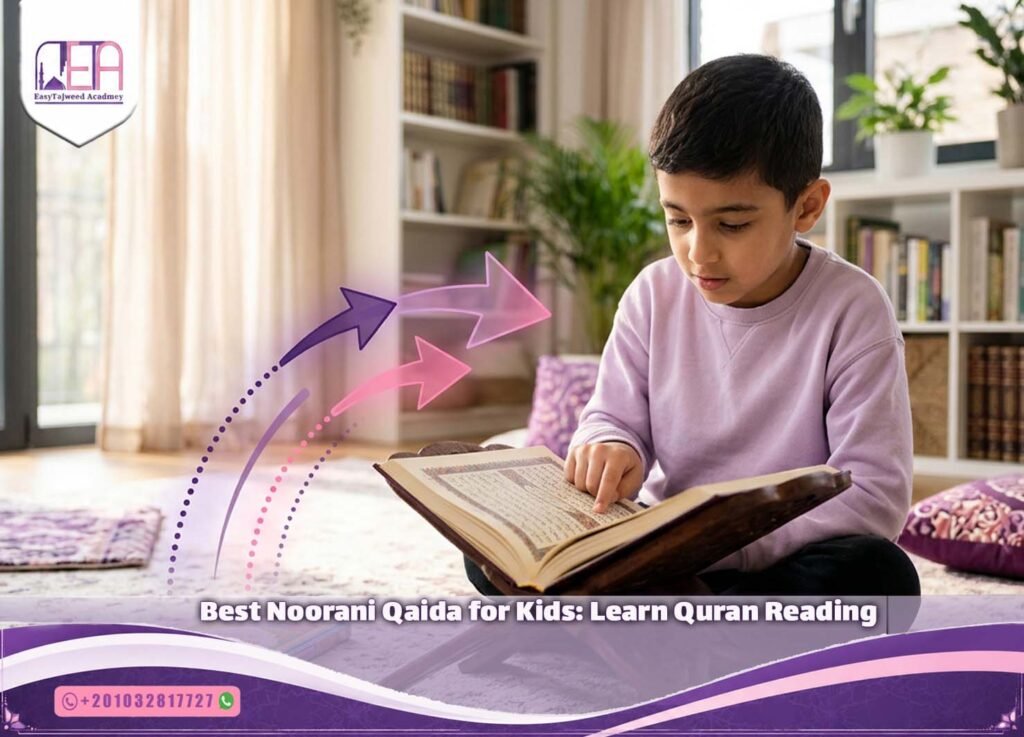
Noorani Qaida for kids is a popular, simplified method for teaching the basics of Quranic Arabic. It uses a step-by-step approach with phonetic sounds, simple words, and engaging visuals to help kids learn to read and recite the Quran accurately.
Noorani Qaida for kids is designed specifically for young learners; it focuses on correct pronunciation (tajweed), letter formation, and foundational vocabulary. Structured Noorani Qaida lessons make it ideal for beginners aged 4–8. Many parents and teachers prefer it for its clarity and child-friendly format.
Helping children develop a strong foundation in Quran reading is one of the most valuable steps parents can take in their Islamic education journey. However, before children can read the Holy Quran confidently, they need to recognize Arabic letters, understand their sounds, and learn how to pronounce them correctly.
Noorani Qaida for kids is a beginner-friendly learning method that introduces children to Quranic Arabic through simple, structured lessons. It takes young learners from recognizing individual Arabic letters to reading connected words and simple Quranic text. Each lesson builds on previously learned skills, making the learning process easier to follow.
For Muslim families in the USA, the UK, Canada, and Australia, online learning offers a convenient way to introduce children to Quran reading from home. With the right teacher, regular practice, and an age-appropriate approach, children can develop their reading skills at a comfortable pace.
In this guide, we explore how Noorani Qaida for kids works, when children should start, what they learn, and how parents can support their progress. We also explain how Easy Tajweed Academy can help young learners begin their Quran education.
What Is Noorani Qaida for Kids?
Noorani Qaida for kids is a foundational learning book and teaching method designed to help beginners read Arabic correctly, particularly when preparing to recite the Holy Quran. It introduces essential Arabic reading concepts in a gradual sequence, allowing children to develop their skills one step at a time.
Noorani Qaida for Kids is an adapted learning approach that makes these lessons accessible to young learners. Instead of asking children to read complete Quranic verses immediately, it starts with individual Arabic letters and gradually introduces more advanced reading patterns.
Understanding the Noorani Qaida Learning Method
The Noorani Qaida learning method follows a structured progression. Children begin by identifying Arabic letters and learning their correct sounds. Once they become familiar with individual letters, they move towards recognizing connected letters and understanding vowel marks.
The lessons gradually introduce important reading concepts, including:
- Arabic letters and their pronunciation.
- Joined Arabic letters and their different forms.
- Short vowel marks, known as Harakat.
- Tanween and its pronunciation.
- Sukoon and Shaddah.
- Long vowel sounds, known as Madd.
- Reading Arabic combinations, words, and simple Quranic text.
Each stage prepares children for the next one. For example, a child who understands individual letters will find it easier to recognize those letters when they appear together in a word.
This step-by-step approach is particularly helpful for kids who have never studied Arabic before.
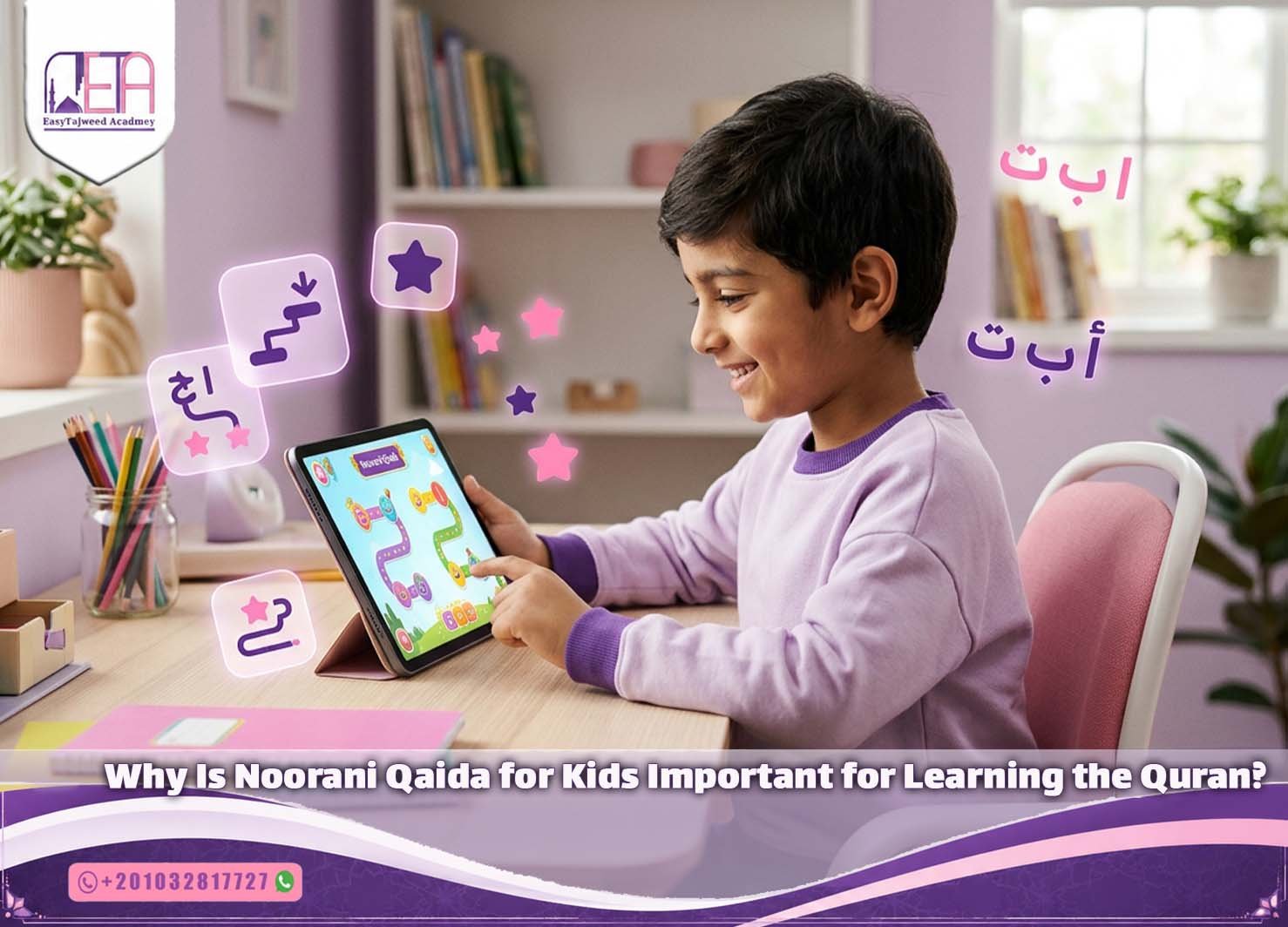
Why Is Noorani Qaida for Kids Important for Learning the Quran?
The Holy Quran is written in Arabic, and reading it correctly requires an understanding of Arabic letters, sounds, and pronunciation patterns.
Children who start reading Quranic text without learning these foundations may struggle with unfamiliar letters or pronounce certain sounds incorrectly.
Noorani Qaida for kids helps address these challenges by developing essential reading skills before children begin reading directly from the Mushaf.
It also introduces foundational pronunciation concepts that support future Tajweed learning. Children become familiar with how Arabic letters sound and how vowel marks influence their pronunciation.
However, completing Noorani Qaida for kids does not mean a child has mastered every Tajweed rule. It provides the foundation for more advanced Quran recitation lessons.
At What Age Should Children Start Learning Noorani Qaida?
One of the most common questions Muslim parents ask is when their children should begin learning Noorani Qaida for kids.
There is no single perfect age for every child. Some children show an interest in Arabic letters during preschool, while others are more comfortable beginning structured lessons when they start school.
The most important factors are the child’s readiness, attention span, learning ability, and interest.
Introducing Noorani Qaida to Preschool Children
Children around four or five years old can begin recognizing Arabic letters through simple and enjoyable activities.
At this stage, lessons should focus on familiarizing children with letter shapes and sounds rather than expecting them to read independently.
Parents and teachers can use:
- Colourful Arabic alphabet flashcards.
- Short pronunciation activities.
- Repetition and listening exercises.
- Simple letter-recognition games.
- Visual learning materials.
Young children usually benefit from short lessons with frequent repetition. A teacher should introduce a small number of letters at a time and allow children to practise before moving forward.
It is also important to avoid overwhelming preschool learners with lengthy explanations or difficult exercises.
Noorani Qaida for School-Age Kids
Children between six and twelve years old can follow more structured Noorani Qaida lessons.
At this age, many children have developed stronger attention, memory, and reading abilities. They may find it easier to recognize Arabic letters, understand vowel marks, and practise reading simple combinations.
A structured learning programme can help them progress from basic alphabet recognition to reading connected Arabic words.
Regular Quran practice alongside school education can also help children develop consistency. However, parents should choose lesson times that fit their child’s daily routine.
Can Older Children and Complete Beginners Learn Noorani Qaida?
Absolutely. Children who have not started Quran lessons at an early age can still learn Noorani Qaida successfully.
Some children begin at eight, ten, or even twelve years old. Others may recognize Arabic letters but struggle with pronunciation or reading connected words.
The best approach is to assess each child’s current ability and start from the appropriate level.
Parents should avoid comparing their child’s progress with that of siblings or classmates. Children develop reading skills at different rates, and consistent practice is more valuable than rushing through lessons.
What Do Children Learn in Noorani Qaida? (Step-by-Step Lessons)
The most important part of Noorani Qaida for children is its structured curriculum. Each lesson introduces a specific Arabic reading concept and prepares children to understand more complex combinations.
Here are the main learning stages children typically encounter.
1. Learning the Arabic Alphabet (Huroof Mufradat)
The first stage is Noorani Qaida for kids to learn the Arabic alphabet, which consists of 28 commonly recognized letters.
Children learn to recognize each letter individually and understand its correct pronunciation.
For example:
- ا – Alif
- ب – Baa
- ت – Taa
- ث – Thaa
- ج – Jeem
- ح – Haa
- خ – Khaa
Some Arabic letters have similar shapes but different dots or pronunciations. For example, ب (Baa), ت (Taa), and ث (Thaa) share a similar basic shape but have different dot arrangements.
Children need to understand these differences rather than memorizing letter names alone.
They should also practise producing Arabic sounds correctly. Some letters, such as ع (Ayn), ح (Haa), and خ (Khaa), may be unfamiliar to children who speak English at home.
A qualified Quran teacher can demonstrate the correct pronunciation and help children practise each sound.
2. Recognizing Joined Arabic Letters in Noorani Qaida for Kids
After learning individual Arabic letters, children move on to recognizing how letters connect within words.
Unlike English, Arabic is written from right to left, and most letters change their appearance depending on their position.
A letter may appear in an isolated, initial, medial, or final form.
For example, the letter ب can appear as:
- Isolated: ب
- Initial: بـ
- Medial: ـبـ
- Final: ـب
Learning these forms helps children recognize Arabic letters when they appear in connected words.
Teachers should introduce simple combinations first and gradually increase the difficulty.
This stage is important because recognizing individual letters does not automatically mean a child can read connected Arabic text.
3. Understanding Harakat in Noorani Qaida for Kids
Harakat (Fatha, Kasra, and Damma) are short vowel marks placed above or below Arabic letters. They help readers understand how each letter should be pronounced.
Noorani Qaida for kids introduces three basic vowel marks:
Fatha (َ): A small mark above a letter that produces a short ‘a’ sound.
Example: بَ (Ba)
Kasra (ِ): A small mark below a letter that produces a short ‘i’ sound.
Example: بِ (Bi)
Damma (ُ): A small mark above a letter that produces a short ‘u’ sound.
Example: بُ (Bu)
Children learn to recognize these marks and understand how they change the sound of a letter.
For example, the letter ب has the same basic shape in all three examples, but its pronunciation changes depending on the vowel mark.
Teachers should provide plenty of reading practice so children become comfortable identifying Harakat without hesitation.
4. Learning Tanween (Double Vowel Marks)
Tanween is another important concept introduced in Noorani Qaida. It involves double vowel marks that generally produce an additional ‘n’ sound at the end of a word when reading.
There are three types:
- Fathatain (ً): Produces an an sound.
- Kasratain (ٍ): Produces an in sound.
- Dammatain (ٌ): Produces an un sound.
For example:
- بً
- بٍ
- بٌ
Children learn to recognize these marks and understand how they affect pronunciation.
This stage prepares young learners for reading more complex Arabic combinations and Quranic words.
A teacher should demonstrate each sound clearly and allow children to repeat it before moving to longer reading exercises.
5. Understanding Sukoon and Shaddah in Noorani Qaida for Kids
Sukoon and Shaddah in Noorani Qaida for kids are two essential Arabic reading signs that children need to understand before progressing to more advanced Quran reading.
Sukoon (ْ) indicates that a letter has no vowel sound of its own. It connects the letter to the preceding sound during pronunciation.
For example:
بَتْ
Children learn to pronounce the combination smoothly rather than adding an unnecessary vowel after the letter with Sukoon.
Shaddah (ّ) indicates that a letter is doubled or stressed. It represents two instances of the same letter sound, with the first carrying Sukoon and the second carrying a vowel.
For example:
رَبَّ
Children should learn to pronounce the doubled letter correctly without separating it unnaturally.
These concepts require listening, repetition, and teacher feedback. Regular exercises help children recognize Sukoon and Shaddah when reading Arabic words.
6. Learning Madd (Long Vowel Sounds) In Noorani Qaida for Kids
Madd refers to the elongation of vowel sounds during Arabic reading and Quran recitation.
Noorani Qaida introduces children to the three main letters of Madd:
- Alif (ا), which follows Fatha.
- Waw (و), which follows Damma.
- Yaa (ي), which follows Kasra.
Examples include:
- قَالَ
- يَقُولُ
- قِيلَ
Children learn that these letters can extend the preceding vowel sound.
This concept is important because Quran recitation requires readers to distinguish between short and long vowel sounds.
At the beginner stage, children focus on recognizing and practising basic Madd patterns. More detailed elongation rules can be introduced during subsequent Tajweed lessons.
7. Reading Arabic Words and Simple Quranic Texts
After studying the previous lessons, children begin combining their knowledge to read complete Arabic words.
They use their understanding of letters, connected forms, Harakat, Tanween, Sukoon, Shaddah, and Madd to decode increasingly complex reading examples.
This is an important transition because children begin applying individual concepts together rather than studying them separately.
A teacher can introduce familiar Quranic words and simple reading exercises to build confidence.
As children improve, they can gradually prepare to read directly from the Mushaf.
The goal is not simply to finish the book quickly. It is to develop accurate reading habits that will support their future Quran recitation.
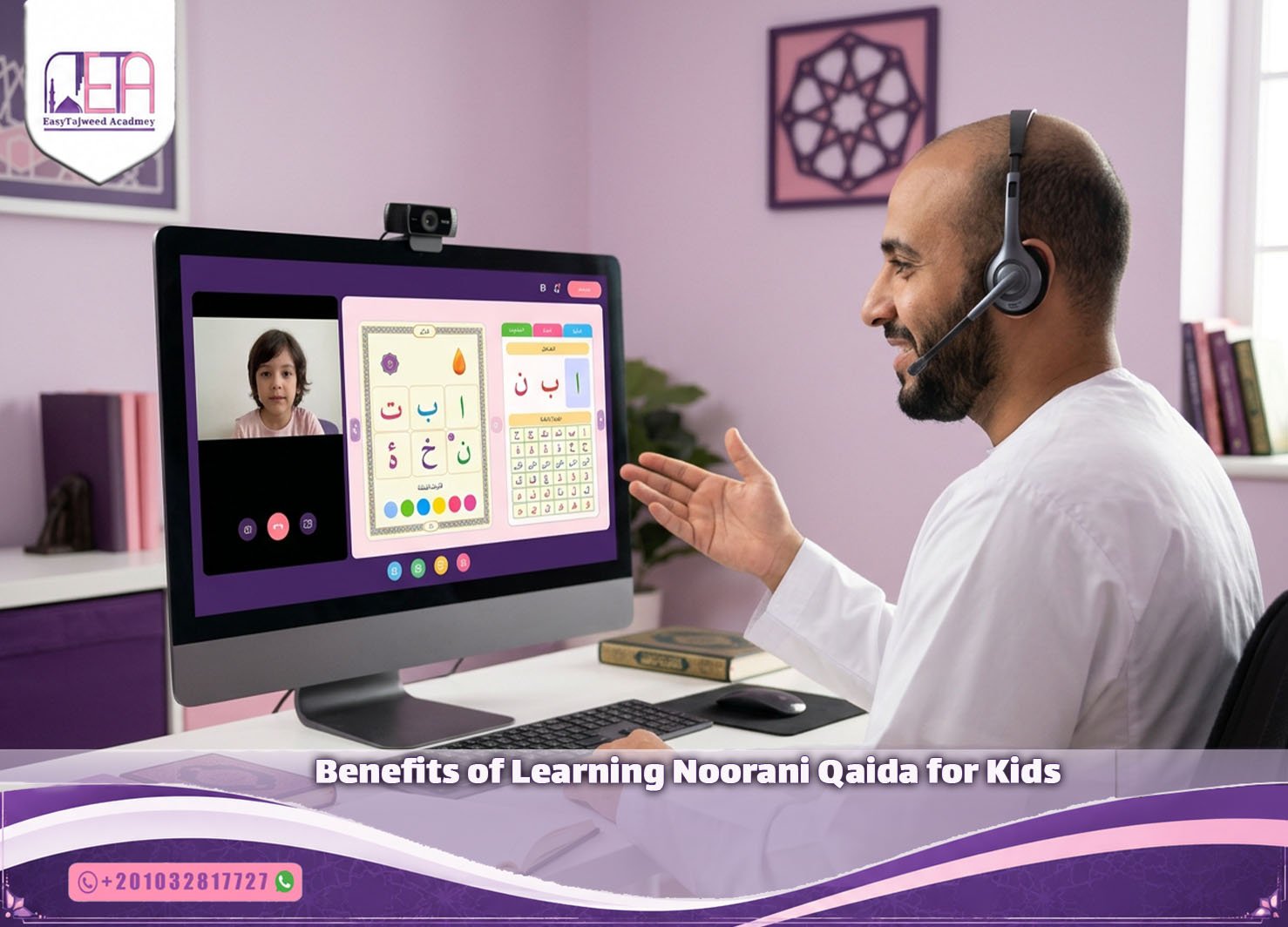
Benefits of Learning Noorani Qaida for Kids
Helping Noorani Qaida for kids build a strong foundation in Quranic Arabic pronunciation, enabling accurate recitation from an early age.
Learning Noorani Qaida for kids offers several educational and spiritual benefits. Beyond teaching them how to recognize Arabic letters, it helps them develop the essential skills needed for accurate Quran reading.
Here are some important benefits parents should understand.
Builds Strong Quran Reading Foundations
One of the main benefits of Noorani Qaida for kids is that it establishes a strong foundation for future Quran learning.
Children begin with simple concepts and gradually move towards more challenging reading exercises. This progression helps them understand how Arabic letters work together to form words.
Instead of memorizing Quranic verses without understanding basic reading patterns, children learn how to recognize and pronounce the letters independently.
These foundational skills can make the transition to reading the Mushaf easier and more comfortable.
Improves Arabic Letter Recognition and Pronunciation
Some Arabic letters may look or sound unfamiliar to children who grow up speaking English or another non-Arabic language.
Noorani Qaida provides repeated opportunities to recognize these letters and practise their sounds.
For example, children learn to distinguish between letters with similar shapes, such as ب (Baa), ت (Taa), and ث (Thaa). They also practise producing sounds from different articulation points.
With regular listening and repetition, children can gradually improve their ability to identify and pronounce Arabic letters.
Develops Confidence in Quran Recitation
Children may initially feel nervous when asked to read Arabic words or Quranic verses.
However, learning through manageable stages can make the experience less intimidating.
As children master individual letters, vowel marks, and simple combinations, they begin to recognize familiar patterns. This progress can encourage them to participate more confidently in Quran lessons.
Positive feedback from parents and teachers also helps children stay motivated.
Prepares Children for Learning Tajweed
Tajweed is the set of rules that guides the correct pronunciation and recitation of the Holy Quran.
Before studying more advanced Tajweed concepts, children need to understand Arabic letters and basic reading patterns.
Noorani Qaida introduces foundational skills that support this learning process, including correct letter pronunciation, short and long vowels, Sukoon, and Shaddah.
Later, children can build on these skills when studying Makharij al-Huroof, Noon Sakinah and Tanween, Meem Sakinah, Ghunnah, and other Tajweed rules.
How to Teach Noorani Qaida to Kids Effectively
Teaching Noorani Qaida for kids requires patience, consistency, and an understanding of how children learn. Parents do not need to be professional Quran teachers to support their children’s progress. However, following a structured approach can make home practice more productive.
Start with Simple Arabic Letters
Begin by introducing individual Arabic letters before moving to connected forms or vowel combinations.
Allow children to recognize each letter visually and listen to its correct pronunciation.
Avoid introducing too many unfamiliar letters in one session. Instead, focus on a manageable number and review previously learned letters regularly.
For example, parents can show children the letters ب، ت، and ث and ask them to identify each one by its shape and sound.
Once children recognize these letters confidently, they can move on to additional letters.
Use Repetition and Listening Practice
Children learn pronunciation more effectively when they hear correct sounds repeatedly and practise producing them.
Parents can encourage their children to listen carefully to their teacher and repeat the sounds.
However, repetition should involve more than simply memorizing a sequence. Children should understand which letter they are pronouncing and how its sound differs from similar letters.
Listening to a qualified Quran teacher is especially important when children encounter Arabic sounds that do not exist in their first language.
Make Learning Interactive and Enjoyable
Young learners are more likely to stay engaged when lessons include activities that suit their interests.
Parents can introduce simple activities such as:
- Arabic alphabet flashcards.
- Letter-matching games.
- Colourful learning charts.
- Short pronunciation challenges.
- Listening and repetition exercises.
- Simple quizzes about previously studied letters.
These activities can make basic Arabic for kids more enjoyable while reinforcing the concepts taught during formal lessons.
The activities should support learning rather than distract children from their main reading goals.
Correct Pronunciation from the Beginning
One of the most important parts of learning Noorani Qaida for kids is developing correct pronunciation habits.
Children may confuse similar Arabic sounds or pronounce certain letters using the wrong articulation point.
If these mistakes are not identified, they may become difficult to correct later.
A qualified Quran teacher can listen to the child’s recitation, identify mistakes, demonstrate the correct sounds, and provide individual feedback.
Parents can reinforce these corrections during home practice without putting unnecessary pressure on their children.
Online Noorani Qaida Classes for Kids
For Muslim families living in the USA, UK, Canada, and Australia, finding convenient Quran lessons can sometimes be challenging.
Parents may have busy work schedules, children may attend full-time schools, and a suitable local Quran teacher may not always be available.
Online Noorani Qaida Classes for Kids offer another way to access structured Quran education without travelling to a physical learning centre.
However, the quality of the teaching programme matters more than whether lessons take place online or in person.
Why Choose Easy Tajweed Academy for Noorani Qaida for Kids?
Choosing the right learning environment can make a meaningful difference in a child’s Quran education. Parents need a programme that combines structured lessons, clear explanations, regular practice, and an understanding of children’s individual learning needs.
Easy Tajweed Academy is a learning option for families exploring online Quran education and Noorani Qaida lessons for young beginners.
When choosing a programme, parents should look for the following important learning features.
Qualified Quran Teachers Who Understand Children’s Needs
Children need teachers who can explain Arabic pronunciation in a simple and understandable way.
An effective Quran instructor should understand the challenges beginners face, particularly when learning unfamiliar Arabic sounds.
Teachers should be able to demonstrate correct letter articulation, identify pronunciation mistakes, and encourage children to practise without feeling embarrassed.
A supportive teaching environment can help young learners become more comfortable reading Arabic aloud.
Personalized Noorani Qaida Lessons for Young Learners
Every child has a different learning pace. Some children recognize Arabic letters quickly but need additional pronunciation practice. Others understand individual letters but struggle when reading connected words.
Personalized lessons help address these differences.
When exploring Noorani Qaida classes at Easy Tajweed Academy, parents should consider how the learning programme assesses children’s abilities, adapts lesson difficulty, and provides opportunities for revision.
The aim should be to help each child develop genuine reading skills rather than simply complete lessons as quickly as possible.
Flexible Online Quran Classes for Families Worldwide
Online learning can make Quran education more accessible to Muslim families living in different countries.
Parents in the USA, UK, Canada, and Australia can look for lesson schedules that accommodate their children’s school hours, family responsibilities, and local time zones.
Learning from home also removes the need for regular travel to a physical Quran centre.
This flexibility can help families maintain a consistent Quran learning routine.
Give your child a confident start with Noorani Qaida for kids. Explore the learning opportunities at Easy Tajweed Academy and help your child develop the essential skills needed to read the Holy Quran.
What Comes After Completing Noorani Qaida for Kids?
Completing Noorani Qaida for kids is an important achievement, but it is only the beginning of a child’s Quran learning journey.
After developing basic Arabic reading skills, children can move towards more advanced Quran studies.
The next stage should depend on their reading accuracy, pronunciation, and readiness.
Moving to Quran Reading (Nazra Quran)
Nazra Quran refers to reading the Holy Quran directly from the Mushaf.
At this stage, children begin applying the skills they developed through Noorani Qaida to actual Quranic verses.
They practise recognizing Arabic words, reading vowel marks, and pronouncing Quranic text correctly.
Teachers should begin with manageable passages and gradually introduce longer verses as children’s reading improves.
Regular reading practice is important because children need time to become familiar with the language and structure of Quranic text.
Learning Basic Tajweed Rules After Completing Noorani Qaida for Kids
After developing basic reading skills through Noorani Qaida for kids, children can begin studying Tajweed more systematically.
Tajweed teaches Muslims how to recite the Holy Quran according to established pronunciation rules.
Some important topics include:
- Makharij al-Huroof: Learning the correct articulation points of Arabic letters.
- Noon Sakinah and Tanween: Understanding the rules of Izhar, Idgham, Iqlab, and Ikhfa.
- Meem Sakinah: Learning the rules of Ikhfa Shafawi, Idgham Shafawi, and Izhar Shafawi.
- Ghunnah: Understanding nasalization in Quranic recitation.
- Madd rules: Learning when and how vowel sounds should be elongated.
These concepts help children improve their recitation accuracy and develop a better understanding of Quranic pronunciation.
Frequently Asked Questions About Noorani Qaida for Kids
What is the best age to start Noorani Qaida for kids?
Many children can begin learning Noorani Qaida around the ages of four or five, starting with Arabic letter recognition and simple pronunciation activities. However, there is no strict age requirement. Children aged six to twelve and older beginners can also start successfully. The best starting age depends on a child’s attention span, readiness, and learning ability.
How long does it take a child to complete Noorani Qaida?
The completion time varies depending on the child’s age, previous Arabic knowledge, lesson frequency, and home practice. Some children progress faster, while others need additional revision to master pronunciation and reading patterns. Parents should focus on accurate reading and understanding rather than rushing to finish the book. A qualified teacher can assess progress and recommend an appropriate learning schedule.
Can children learn Noorani Qaida online?
Yes. Children can learn Noorani Qaida for kids through live online classes with a qualified Quran teacher. Online lessons allow teachers to demonstrate Arabic pronunciation, listen to children’s reading, and correct mistakes in real time. Parents should choose a structured programme with child-friendly teaching methods, interactive lessons, regular revision, and individual feedback.
What should children learn after completing Noorani Qaida?
After completing Noorani Qaida for kids, children can begin reading the Holy Quran directly from the Mushaf through Nazra lessons. They can also start learning basic Tajweed rules, including Makharij al-Huroof, Noon Sakinah and Tanween, Meem Sakinah, Ghunnah, and Madd. Children who are ready may also begin memorizing short Surahs from Juz Amma with regular revision and teacher guidance.
Conclusion: Give Your Child the Right Start with Noorani Qaida
Learning Noorani Qaida for Kids is an important first step towards developing strong Quran reading skills. It helps children recognize Arabic letters, understand pronunciation, and gradually progress from individual letters to complete Quranic words.
With patient teaching, regular practice, and an age-appropriate learning approach, children can develop the confidence needed for their future Quran studies.
For parents seeking convenient online Quran education, Easy Tajweed Academy is worth exploring as a learning option.
Help your child begin their Quran journey with confidence. Explore Noorani Qaida learning opportunities at Easy Tajweed Academy and take the first step towards a lifelong connection with the Holy Quran.
